The short answer: an 8 oz cup of brewed coffee has about 95 mg of caffeine. But most people drink 12 to 20 oz, and the FDA puts a 12 oz cup of regular brewed coffee at 113 to 247 mg. Size and brew method change the number more than the brand of coffee does.
This guide is for information only. It is not medical advice. If you are pregnant, have a heart condition or take medicine, ask your doctor how much caffeine is right for you.
Caffeine in a Cup of Coffee: Quick Chart
Use this chart as a rule of thumb for coffee you brew at home. Real cups vary with the beans, the grind and how strong you make it.
| Cup size | Caffeine (approx.) | Notes |
|---|---|---|
| 8 oz (a small diner cup) | About 95 mg | The figure most sites quote as the average |
| 12 oz (a standard mug) | About 140 mg | The FDA range for 12 oz is 113 to 247 mg |
| 16 oz (a large mug) | About 190 mg | Calculated at the same strength as 8 oz |
| 20 oz (a cafe large) | About 240 mg | Calculated, cafes often brew stronger |

Why you will see different numbers
Search for this question and you will find several answers. One site says 70 to 200 mg, another says 60 to 100 mg, another says 140 to 240 mg. They are not all wrong. They are measuring different things.
- Cup size. A 6 oz cup and a 20 oz cup are both “a cup of coffee.”
- Strength. More coffee per cup of water means more caffeine.
- The coffee itself. Bean type, brew method and brew time all change the result.
The best habit is to think in ounces and milligrams, not “cups.”
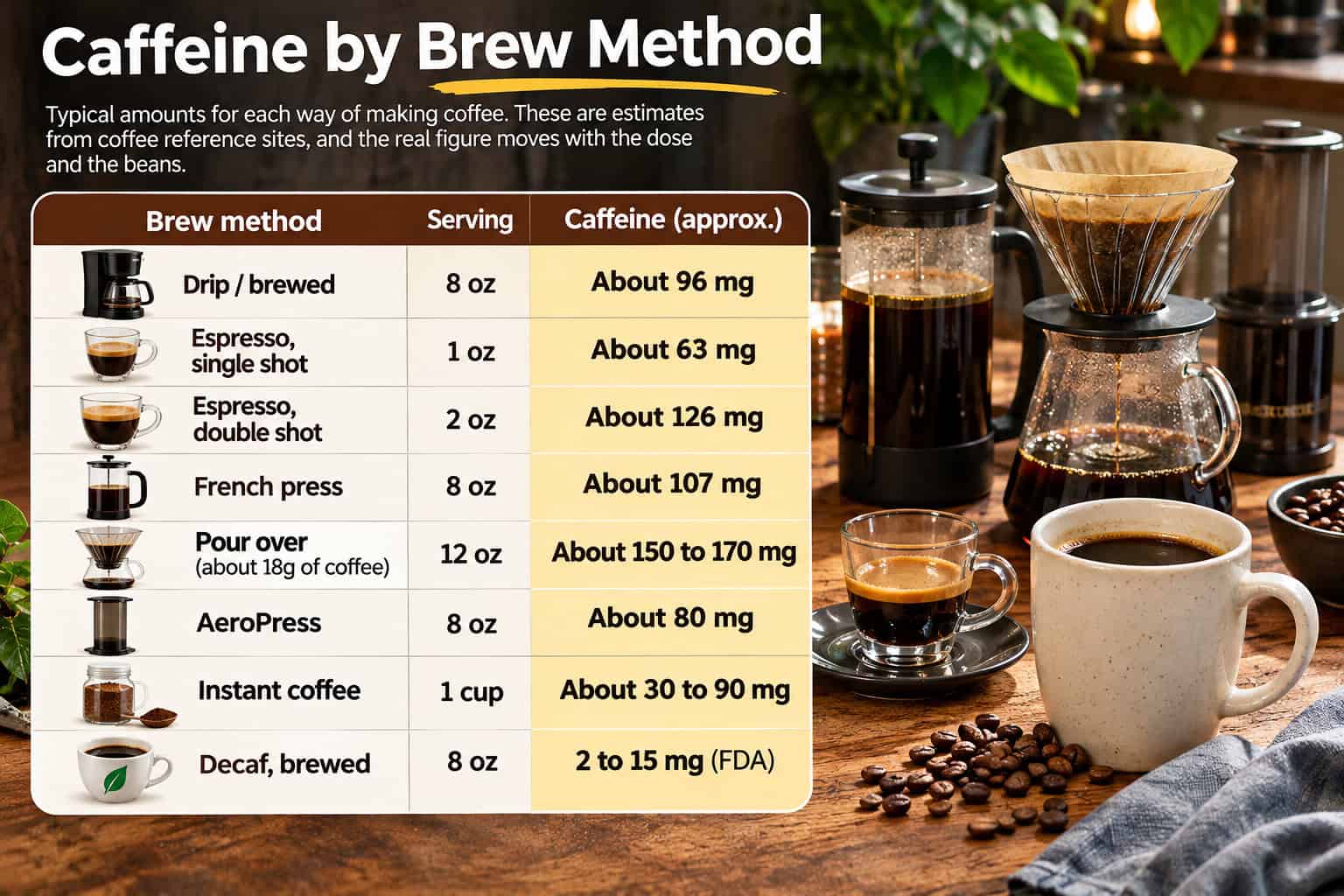
Caffeine by Brew Method
Here are typical amounts for each way of making coffee. These are estimates from coffee reference sites, and the real figure moves with the dose and the beans.
| Brew method | Serving | Caffeine (approx.) |
|---|---|---|
| Drip / brewed | 8 oz | About 96 mg |
| Espresso, single shot | 1 oz | About 63 mg |
| Espresso, double shot | 2 oz | About 126 mg |
| French press | 8 oz | About 107 mg |
| Pour over (about 18g of coffee) | 12 oz | About 150 to 170 mg |
| AeroPress | 8 oz | About 80 mg |
| Instant coffee | 1 cup | About 30 to 90 mg |
| Decaf, brewed | 8 oz | 2 to 15 mg (FDA) |
Espresso: strong per ounce, not per drink
Espresso has the most caffeine per ounce, because it is made with finely ground beans and pressure. But a shot is only an ounce or two. A latte made with one shot usually has less caffeine than a big mug of drip coffee.
So the right comparison is the whole drink. A double espresso at about 126 mg is close to a 12 oz cup of drip. If you drink espresso at home, see our guides to the best espresso machines under $300 and the best coffee beans for espresso.
Cold brew
Cold brew is made with a lot of coffee and a long steep, so the concentrate is strong. Most people dilute it, so the final cup varies a lot. One chain example: a grande (16 oz) Starbucks cold brew is listed at about 205 mg. See our best cold brew coffee makers if you make your own.
French press and pour over
Immersion brewing and a longer contact time pull out more caffeine. That is why a French press often tests a little higher than drip. Pour over depends on how much coffee you use. Our guides to the best French press coffee makers and best pour over coffee makers show the gear and the ratios.
Instant coffee
Instant coffee usually has less, about 30 to 90 mg a cup. If you want a milder cup, see our picks for the best instant coffee.
Decaf is not caffeine-free
Decaf still has some caffeine. The FDA lists 2 to 15 mg in an 8 oz cup. Mayo Clinic also notes that decaf “still has some caffeine.” That is small, but if you are very sensitive, it adds up over several cups. Our best decaf coffee beans guide has the options.
Caffeine at Coffee Chains
Chain coffee is stronger and bigger than the coffee you make at home. These figures come from the Caffeine Informer reference site and other third-party charts. Chains change recipes and sizes, so check the chain’s app or website for the current number.
Starbucks brewed coffee
| Size | Pike Place (medium) | Blonde | Dark roast | Decaf Pike Place |
|---|---|---|---|---|
| Short (8 oz) | 155 mg | 180 mg | 130 mg | 15 mg |
| Tall (12 oz) | 235 mg | 270 mg | 195 mg | 20 mg |
| Grande (16 oz) | 310 mg | 360 mg | 260 mg | 25 mg |
| Venti (20 oz) | 410 mg | 475 mg | 340 mg | 30 mg |
Two things to notice. First, a single Venti Pike Place at 410 mg is already over the 400 mg daily guide. Second, the Blonde (light) roast has more caffeine than the dark roast, which surprises many people. Some newer charts list slightly different figures, such as 315 mg for a grande, so treat these as close estimates. For prices and the full menu, see our Starbucks menu prices guide.
Dunkin hot brewed coffee
Dunkin lists four hot sizes. For the Original Blend, charts show about 180 mg in a small (10 oz), 210 mg in a medium (14 oz), 270 mg in a large (20 oz) and 330 mg in an extra large (24 oz). Another page lists the large at 300 mg and the extra large at 359 mg, so expect some range.
McDonald’s coffee
McDonald’s premium roast is milder. Third-party charts give about 109 mg in a small (12 oz), 145 mg in a medium (16 oz) and roughly 180 to 185 mg in a large. McDonald’s does not publish caffeine for its coffee, so these are estimates.
Dutch Bros and others
Drink sizes and shot counts change the caffeine in specialty drinks a lot. We do not list Dutch Bros numbers here because they are not published in a form we could confirm. For the drinks and home options, see our Dutch Bros coffee guide. Fast food menus are covered in our Wendy’s menu guide.
What Changes the Caffeine in Your Cup
Cup size
This is the biggest factor, by far. A 20 oz coffee has more than twice the caffeine of an 8 oz one.
Bean type
Robusta beans usually have much more caffeine than arabica, often about double. Most specialty coffee is arabica. Some instant and cheap blends add robusta.
Roast level
People often think dark roast has more caffeine. It usually does not. Roasting changes caffeine very little. The Starbucks chart above shows the Blonde roast ahead of the dark. If you measure by scoop instead of weight, a dark roast can seem weaker because the beans are lighter. Our guide to coffee roasting and our look at white coffee and light roast myths go deeper.
Dose and ratio
More grounds per cup of water means more caffeine. If you want to control it, weigh your coffee. A scale helps, and we list the best in our coffee scale guide.
Brew time and grind
A finer grind and a longer brew pull out more caffeine, up to a point. It also changes the taste. If your cup tastes harsh, read why coffee tastes bitter.
Milk and sugar
Adding milk, cream or syrup does not change the amount of caffeine. It only makes the drink bigger or sweeter.
How Much Caffeine Is Too Much?
Both the FDA and Mayo Clinic point to 400 mg a day for most healthy adults. The FDA says that is an amount not generally associated with negative effects. Mayo Clinic says it is about four cups of brewed coffee.
That is a guide, not a rule. People clear caffeine at very different speeds. Some feel shaky after one cup. Others feel fine after four.
Signs you have had too much
Mayo Clinic lists these signs of too much caffeine:
- Headache
- Trouble sleeping
- Feeling nervous or cranky
- A fast heartbeat
- Shaky muscles
- Upset stomach
- Needing to urinate often
If you drink more than four cups a day or notice these, consider cutting back.
Very high doses are dangerous
The FDA says toxic effects such as seizures can occur with rapid consumption of about 1,200 mg of caffeine. Pure and highly concentrated caffeine powders and liquids can be very dangerous. Coffee is not the risk here, but concentrated products are.
Pregnancy, children and health conditions
Neither the FDA nor Mayo Clinic gives one number for pregnancy. Both advise people who are pregnant, trying to get pregnant or breastfeeding to talk with their health care provider about limiting caffeine. Mayo Clinic also says caffeine is not a good idea for children. If you have a medical condition, ask your doctor.
Coffee vs Other Drinks
For comparison, here are FDA figures for typical 12 fl oz servings:
| Drink (12 fl oz) | Caffeine |
|---|---|
| Regular brewed coffee | 113 to 247 mg |
| Energy drink | 41 to 246 mg |
| Black tea | 71 mg |
| Green tea | 37 mg |
| Caffeinated soft drink | 23 to 83 mg |
Mayo Clinic puts 400 mg at roughly 10 cans of cola, or about two energy shot drinks. Coffee has more caffeine than most drinks, but a large energy drink can match it.
How to Cut Back or Get More Caffeine
To drink less
- Use a smaller cup. Going from 16 oz to 8 oz halves your caffeine.
- Mix half regular and half decaf. See our decaf bean picks.
- Switch some cups to instant. Instant usually has less. See the best instant coffee.
- Try low acid coffee if the problem is your stomach. It is a separate issue from caffeine. See best low acid coffee.
- Taper slowly. Cutting out caffeine all at once can cause headaches.
To drink more (or to feel it more)
Use a stronger ratio, a French press or a double shot. Be careful and keep your daily total under the 400 mg guide unless your doctor says otherwise.
How to Turn mg Into Grams
Many people search for caffeine in grams. It is simple. There are 1,000 mg in 1 gram.
- 95 mg = 0.095 g
- 400 mg = 0.4 g
- 1,200 mg = 1.2 g
So a typical cup of coffee has about a tenth of a gram of caffeine.
Caffeine in Coffee FAQ
How much caffeine is in a cup of coffee?
About 95 mg in an 8 oz cup. A 12 oz cup is usually about 140 mg, and the FDA range for 12 oz is 113 to 247 mg.
How many cups of coffee is 400 mg of caffeine?
Mayo Clinic says about four cups of brewed coffee. If your cups are 12 oz or larger, it is closer to three.
How many mg of caffeine are in a shot of espresso?
About 63 mg in a single 1 oz shot. Starbucks lists 75 mg for a solo shot.
Does decaf coffee have caffeine?
Yes, a little. The FDA lists 2 to 15 mg in an 8 oz cup of decaf.
Does dark roast have more caffeine than light roast?
Usually not. Roast level changes caffeine very little. At Starbucks the Blonde roast has more than the dark roast.
Which has more caffeine, espresso or coffee?
Espresso has more per ounce. A full mug of drip coffee usually has more in total than a single shot.
Does cold brew have more caffeine than hot coffee?
It depends on the dilution and the recipe. Cold brew concentrate is strong, but a diluted cup is often similar to or lower than hot coffee. Check the chain or brand if you need an exact number.
How many grams of caffeine are in a cup of coffee?
About 0.1 g. That is 95 mg, and 1,000 mg make 1 g.
Does adding milk reduce caffeine?
No. Milk does not remove caffeine, it just changes the volume and the taste.
Is it safe to drink coffee while pregnant?
Talk to your doctor or midwife. The FDA and Mayo Clinic both advise speaking with a health care provider about limiting caffeine.
The Bottom Line
- A typical cup: about 95 mg in 8 oz, 140 mg in 12 oz.
- Daily guide: up to 400 mg for most healthy adults, about four 8 oz cups.
- Biggest factor: how many ounces you drink, not the brand.
- Chain coffee: often much stronger. A Venti Starbucks Pike Place is about 410 mg.
- Decaf: small amounts, usually 2 to 15 mg.
Know your cup size, count your cups and listen to your body.
Sources
- FDA: Spilling the Beans: How Much Caffeine Is Too Much?
- Mayo Clinic: Caffeine: How much is too much?
- Chain figures: Caffeine Informer and other third-party charts, as listed above. Check each chain for current numbers.