

Cold brew and iced coffee aren’t the same drink, even though they end up in the same glass with ice in it. Iced coffee is hot-brewed coffee cooled down, cold brew is coffee steeped in cold water for 12 to 24 hours, and that difference in method changes the chemistry: cold water extracts less acid and fewer bitter compounds than hot water does, which is why cold brew tastes smoother and rounder even before you add anything to it.
You can cold brew in literally any container with a fine mesh or paper filter, but a dedicated maker solves the two annoying parts: keeping the grounds contained during the long steep, and separating concentrate from grounds cleanly afterward without straining through a sock. We picked these based on what actually matters for a daily routine: capacity, how airtight the storage really is, and how much of a pain cleanup is. Below is the quick-comparison table, then the full picks.
Quick Comparison
| Cold Brew Maker | Best For | Capacity | Material | Filter Type |
|---|---|---|---|---|
| Takeya Deluxe Cold Brew Maker | Best Overall | 1 quart (32oz) | BPA-free Tritan | Fine-mesh, reusable |
| OXO Good Grips Cold Brew Maker | Best for Easy Cleanup | 32oz concentrate | Borosilicate glass | Stainless mesh, reusable |
| Toddy Cold Brew System | Best for Large Batches | Up to 38oz concentrate | BPA-free plastic | Felt (reusable) or paper |
| Hario Mizudashi | Best Compact/Glass | 1000ml (34oz) | Heatproof borosilicate glass | Fine-mesh, reusable |
| Ovalware RJ3 | Best Budget/Dual-Use | 1.0L (34oz) | Borosilicate glass | Dual stainless steel, reusable |
Takeya Deluxe Cold Brew Coffee Maker, 1 Quart – Best Overall

Takeya is the cold brew maker most people already own, and the reason comes down to a genuinely airtight lid, one tight enough that you can lay the pitcher on its side in the fridge door without a drip. That matters more than it sounds like it would, a lid that seals loosely lets the concentrate slowly oxidize, which is how cold brew goes flat and stale days before you’d expect.
The BPA-free Tritan body is shatterproof, which is the real advantage over glass here, this is a pitcher that lives in a crowded fridge door getting knocked around, and it survives that treatment without a second thought. The fine-mesh filter built into the lid separates grounds from concentrate as you pour, so there’s no separate straining step.

The tradeoff for that convenience is extraction strength. Takeya’s built-in filter isn’t quite as fine as a dedicated felt or paper filter system, so the concentrate comes out a notch weaker than what you’d get from a Toddy at the same coffee-to-water ratio, some reviewers describe it as needing a slightly higher ratio to hit the same strength.
Specs: 1 quart (32oz) capacity, BPA-free Tritan plastic pitcher, airtight leakproof lid, fine-mesh filter, dishwasher safe, made in USA.
Pros: Genuinely airtight and spill-proof even upside down, shatterproof and fridge-door friendly, fully dishwasher safe including the filter, widely available replacement parts.
Cons: Extraction is slightly weaker than felt or paper-filtered systems, may need a stronger coffee-to-water ratio than the Toddy or OXO to match their strength.
Not the right fit if: you want the strongest possible concentrate straight out of the brewer, in which case the Toddy below extracts more intensely.
OXO Good Grips Cold Brew Coffee Maker, 32oz – Best for Easy Cleanup
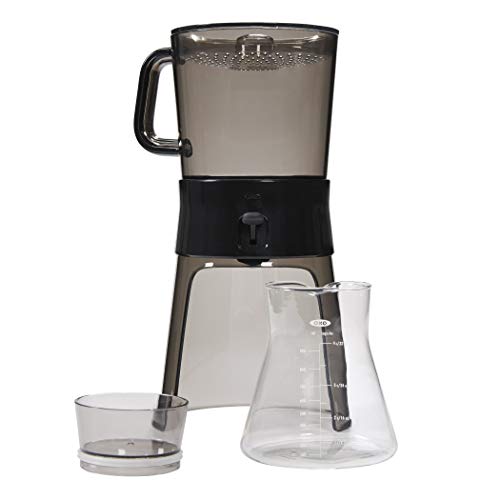
OXO’s design solves cold brew’s messiest moment: separating the grounds from the concentrate once brewing is done. Its “Rainmaker” top evenly saturates the grounds during the steep for more consistent extraction, and once it’s ready, a brew-release switch drains the filtered concentrate straight into the glass carafe below, no lifting a heavy basket of wet grounds or straining anything by hand.
The stainless steel mesh filter is reusable and dishwasher safe, so unlike paper-filter systems there’s no ongoing cost or waste, and the borosilicate glass carafe has clear measurement markings that make dialing in your ratio straightforward.
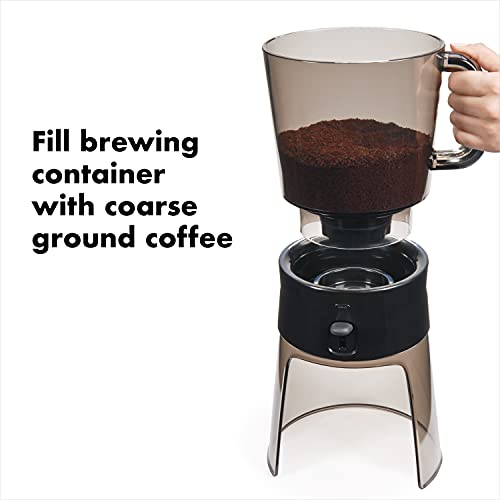
The one consistent complaint across reviews is cleanup of the brewing chamber itself, not the filter or carafe, but the upper compartment where the grounds actually sit, which has enough nooks that some people find it fiddly to get fully clean by hand.
Specs: 32oz borosilicate glass carafe, reusable stainless steel mesh filter, Rainmaker water distribution, brew-release switch, dishwasher-safe filter and carafe.
Pros: Cleanest concentrate-release mechanism of any maker here, reusable filter means no ongoing paper filter cost, glass carafe stores easily and looks good straight from the fridge, measurement markings make ratio tracking easy.
Cons: Upper brewing chamber is more fiddly to clean than the filter or carafe, glass construction means it’s not as drop-proof as Takeya’s Tritan.
Not the right fit if: you want the most shatterproof option for a crowded fridge, in which case the Takeya above is the tougher choice.
Toddy Cold Brew System – Best for Large Batches
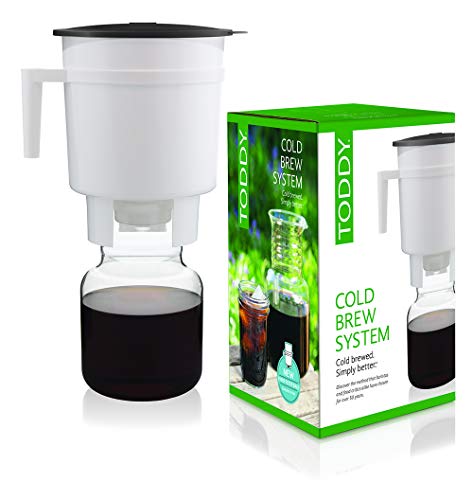
Toddy is the system a lot of coffee shops actually use behind the counter, scaled down for home. It makes up to 38oz of concentrate per batch, enough for around 19 drinks once diluted, more than any other maker on this list, which makes it the right call if you’re brewing for a household or don’t want to restart the process every few days.
It also gives you a genuine choice in filtration: the reusable felt filters that come standard, or the included disposable paper filters for an even cleaner cup. That flexibility is unusual, most makers commit you to one filter type or the other.
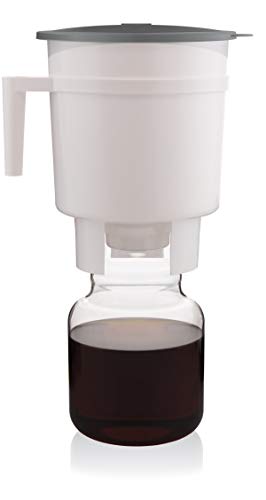
The honest tradeoff is the brewing and draining process itself. Toddy uses a rubber stopper in the bottom of the brewing container that you pull to release the concentrate into a separate glass decanter below, and it’s a two-container system rather than an all-in-one pitcher, which means more parts to manage and, if that stopper isn’t seated correctly, a genuine risk of a slow leak overnight. It’s also the bulkiest option here for fridge storage.
Specs: Up to 38oz concentrate per batch, reusable felt filters plus included disposable paper filters, separate brewing container and glass decanter, rubber stopper release mechanism.
Pros: Largest batch capacity on this list, choice between felt and paper filtration, produces notably strong, full-bodied concentrate, the system professional shops actually scale down from.
Cons: Bulkier two-piece system takes up more fridge space, stopper mechanism has a real failure mode if not seated properly, more parts to wash than an all-in-one pitcher.
Not the right fit if: fridge space is tight or you’re brewing for one person, in which case the compact Hario below takes up far less room.
Hario Mizudashi Cold Brew Pot, 1000ml – Best Compact/Glass
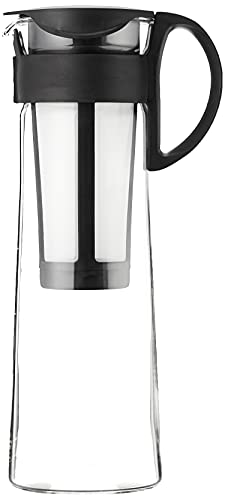
Hario’s approach is about as simple as cold brew gets: grounds go in the fine-mesh basket, water goes over them, the whole thing goes in the fridge, and you pour straight from the same vessel once it’s ready. There’s no separate decanting step and no switch to flip, which makes it the most straightforward maker here if you just want something that gets out of the way.
The heatproof borosilicate glass is genuinely well-made, Hario’s glass manufacturing background goes back to laboratory glassware, and the slender spout gives a controlled, no-drip pour that’s noticeably better than most plastic pitchers. It’s also the most compact option on this list, a real advantage in a crowded fridge door or on a small counter.

The 1000ml capacity is on the smaller side compared to the Toddy or even the OXO, and being glass, it doesn’t have the drop-survivability of the Takeya. It’s also worth noting Hario sells this in both 600ml and 1000ml sizes, so double-check the listing if you want the larger of the two.
Specs: 1000ml (34oz) brewed capacity, heatproof borosilicate glass, removable fine-mesh filter basket, made in Japan, brew and serve from the same vessel.
Pros: Simplest possible brewing process, no separate decanting step, genuinely elegant glass design with a controlled pour spout, most compact footprint here.
Cons: Smaller total capacity than the Toddy or OXO, glass isn’t as drop-resistant as Takeya’s Tritan body, available in a smaller 600ml size too so check before ordering.
Not the right fit if: you’re brewing for more than one or two people regularly, in which case the larger-capacity Toddy above serves more drinks per batch.
Ovalware RJ3 Airtight Cold Brew Maker, 1.0L – Best Budget/Dual-Use
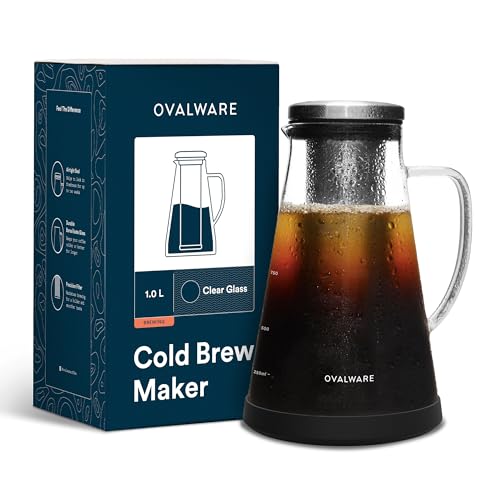
Ovalware’s RJ3 hits a genuinely good price-to-feature ratio: airtight seal, dual stainless steel filters for a cleaner extraction than a single mesh layer, and a design explicitly built to double as an iced tea infuser, not just a coffee maker. If you want one pitcher that handles both cold brew and iced tea without buying two separate vessels, this is the practical choice on this list.
The extra-thick borosilicate glass and laser-cut 18/8 stainless steel filter are a step up in build quality from what the price would suggest, and the airtight silicone seal keeps concentrate fresh in the fridge for up to two weeks, in line with the pricier options here.
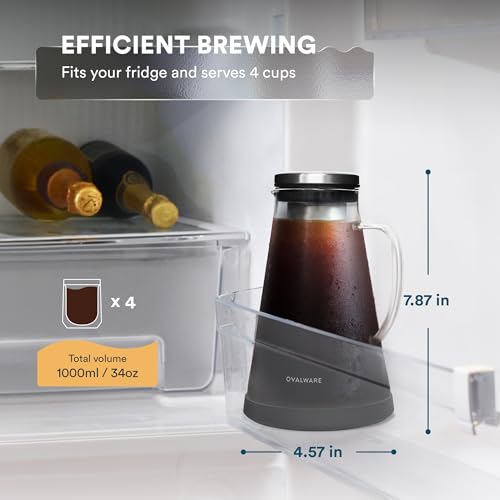
Reviews are mixed specifically on seal consistency, some describe the lid as reliably airtight, others note it can feel slightly loose depending on how it’s seated, which is worth keeping in mind if a bulletproof seal is your top priority. It also comes in a larger 1.5L size if 34oz isn’t enough for your household.
Specs: 1.0L (34oz) capacity, extra-thick borosilicate glass carafe, dual 18/8 stainless steel filters, airtight silicone seal, doubles as a tea infuser.
Pros: Strong value for the build quality, dual filtration for a cleaner cup than single-mesh systems, genuinely useful as a tea infuser too, available in a larger 1.5L size if needed.
Cons: Seal consistency gets mixed feedback, not as bulletproof-airtight as the Takeya by some accounts, glass build means less drop tolerance.
Not the right fit if: an absolutely guaranteed airtight seal is non-negotiable for you, in which case the Takeya above has the more consistently reported seal.
How to Actually Brew Cold Brew (Ratio and Timing)
Regardless of which maker you pick, the fundamentals stay the same. Use a coarse grind, roughly the texture of coarse sea salt, finer grounds will clog most filters and produce a muddier, more bitter concentrate. A standard starting ratio is 1:4, coffee to water by weight, for a strong concentrate you’ll dilute later, or 1:8 if you want something closer to ready-to-drink strength straight out of the fridge.
Steep for 12 to 24 hours in the refrigerator or at cool room temperature. Longer isn’t always better past 24 hours, extraction slows dramatically after the first day, so you’re mostly just risking over-extraction and bitterness rather than gaining meaningful strength. Once it’s done, dilute concentrate roughly 1:1 with water or milk to taste, and always over ice, since cold brew concentrate is genuinely strong straight from the brewer.
Frequently Asked Questions
Is cold brew actually less acidic than hot-brewed coffee?
Yes, meaningfully so. The cold water extraction process pulls out fewer of the acidic compounds that hot water dissolves readily, which is why cold brew tends to be easier on sensitive stomachs and tastes smoother without needing extra sugar or cream to balance sharpness.
How long does cold brew concentrate actually stay fresh?
Most makers with a genuinely airtight seal keep concentrate good for up to two weeks in the fridge. Once you dilute it into a ready-to-drink glass, though, treat that glass like any other coffee, drink it the same day for the best flavor.
Can I use pre-ground coffee, or does it need to be fresh-ground?
Fresh-ground is better, as with any brew method, but cold brew is genuinely more forgiving of pre-ground coffee than a fast hot-water method like espresso, since the long steep time gives even slightly stale grounds more time to extract. Just make sure whatever you use is ground coarse.
Do I need a special coarse-grind setting on my grinder?
Most burr grinders have a coarse setting that works fine, you’re aiming for something visibly chunkier than drip-coffee grind, closer to coarse sea salt than table salt. If you only have a blade grinder, pulse briefly rather than grinding continuously to avoid over-fining unevenly.
Bottom Line
If you want the one pitcher most people would be happy with, the Takeya Deluxe is genuinely hard to beat on durability and fridge-friendliness. If cleanup is your priority, go OXO. Brewing for a household or want the biggest batch, the Toddy is the scaled-down cafe system. Tight on space and want something elegant, the Hario Mizudashi is the simplest and smallest. And if you want strong value that also doubles as a tea pitcher, the Ovalware RJ3 covers both jobs well.
If you’re weighing this against an all-in-one electric option, our best iced coffee makers guide covers electric brewers that handle both hot and cold-style drinks in one machine.


