

Most coffee-drinking households have a version of the same problem. One person wants the speed and convenience of a pod. Another wants a full pot of freshly ground coffee. For years, the solution was two machines crowding the counter — a Keurig on one side, a drip maker on the other. The Ninja DualBrew GP161 is built to end that compromise with a single machine that genuinely does both, and does both well.
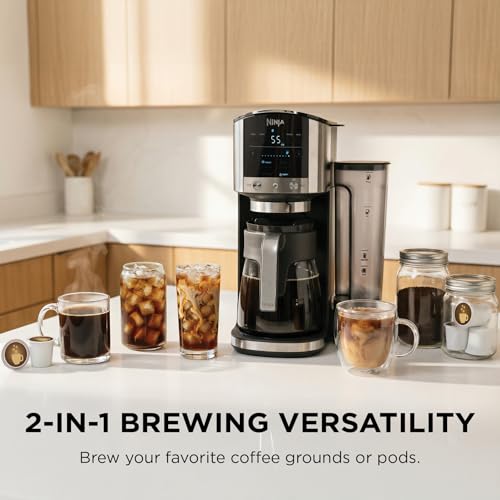
The GP161 is the latest entry in Ninja’s DualBrew line, and it adds something none of the earlier models in the family offered: Rapid Cold Brew technology that produces smooth, full-flavored cold brew in under ten minutes for a single cup and under twenty minutes for a full carafe. No overnight steeping, no planning ahead. Four brew styles total — Classic, Rich, Over Ice, and Cold Brew — combined with nine grounds brew sizes from a single 6 oz cup to a 12-cup carafe and four K-Cup pod sizes make this one of the most configurable mid-range coffee makers on the market today.
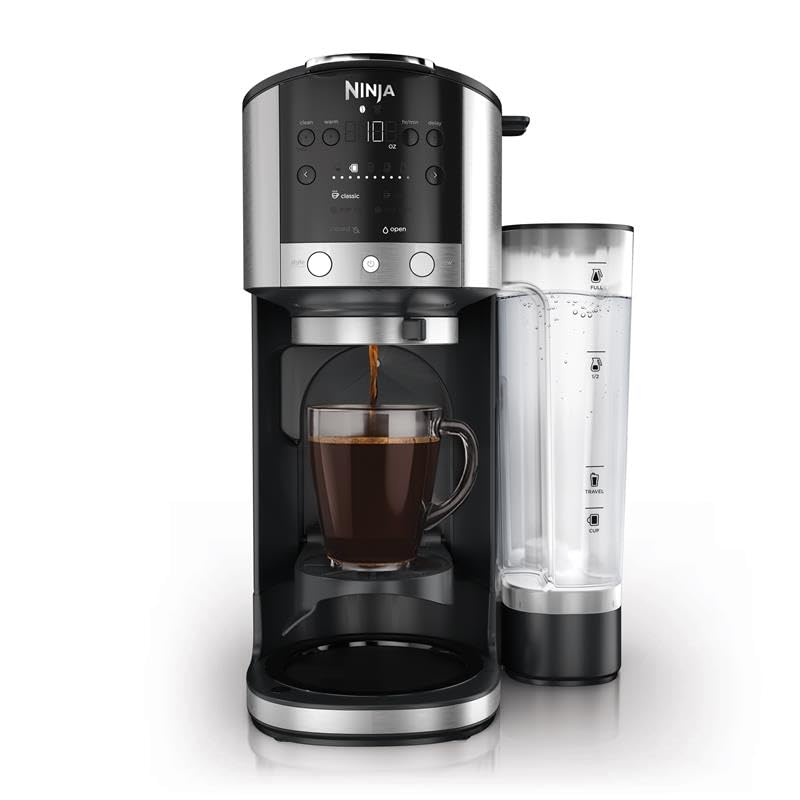
We tested it extensively. Every brew style, multiple roast levels, grounds and pods, morning drip sessions and afternoon cold brew. Here is everything you need to know before you buy.
RoastRig Verdict: The Ninja GP161 DualBrew solves the pods-vs-grounds household debate permanently. Rapid Cold Brew in under 20 minutes, Thermal Flavor Extraction for even saturation at ideal temperature, nine grounds sizes, four brew styles, and an intuitive one-button switch between modes make this one of the best-value dual coffee makers available. The glass carafe and warming plate (rather than a thermal carafe) and the absence of a built-in frother are real limitations for some buyers — but for the right household, this machine is hard to beat at the price.
→ Check the current price on Amazon
Ninja DualBrew GP161: Key Specifications
| Model | GP161 (Ninja DualBrew) |
| ASIN | B0G87LH335 |
| Carafe capacity | 12 cups / glass carafe |
| Water reservoir | 60 oz removable (side or rear position) |
| Brew styles | Classic, Rich, Over Ice, Cold Brew |
| Grounds brew sizes | 9 sizes: 6 oz single cup → 12-cup full carafe |
| Pod brew sizes | 4 sizes: 6, 8, 10, 12 oz |
| Pod compatibility | K-Cup pods (adapter included) |
| Rapid Cold Brew time | ~10 min (single cup) / ~20 min (full carafe) |
| Brewing technology | Thermal Flavor Extraction |
| Warming plate | Adjustable — 3 heat settings, up to 4 hours |
| Carafe type | Glass (not thermal stainless) |
| Built-in frother | No |
| Programmable timer | No |
| Cup tray | Foldable — adjustable mug height |
| Dishwasher-safe parts | Carafe, filter basket, reservoir |
| Included accessories | 12-cup glass carafe, Ninja Smart Scoop, paper filter kit, 60 oz reservoir |
| Approx. price | ~$100–$130 |
| Amazon link | View on Amazon |
Unboxing and First Impressions

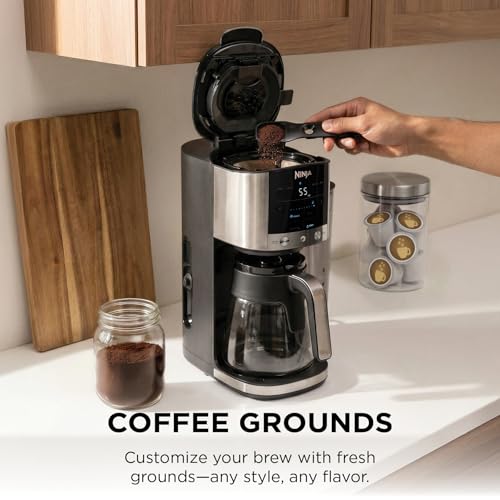
The GP161 arrives in a substantial box, and the contents reflect the machine’s all-in-one ambitions: a 12-cup glass carafe, the 60 oz removable water reservoir, a Ninja Smart Scoop dosing tool, and a paper filter kit. Everything needed for a first brew is in the box — there is no hunting for a compatible filter or measuring device before you can start.
The machine itself makes a strong first impression. The stainless steel exterior paneling gives the GP161 a look that punches above its price point — it does not look like a $120 machine sitting next to kitchen appliances that cost three times as much. The control panel is clean and readable: a brew style selector, a size selector, a brew type toggle between Grounds and Pods modes, and a Start Brew button with a progress indicator bar that illuminates as the brew advances.
The footprint is meaningful. The GP161 is not a small machine — you will want to measure your counter space and cabinet clearance before ordering. With the reservoir positioned on the side, the machine is wide; repositioning it to the rear reduces the width and frees up adjacent counter space, which is a thoughtful design flexibility that competitors at this price point do not always offer.
Setup from unboxing to first brew takes approximately ten minutes: reservoir fill, paper filter insertion, grounds loading, and a quick start. The control panel is intuitive enough that most users will not need the manual for the first brew — though reading the Cold Brew and Over Ice sections before trying those modes is worth the two minutes it takes.
Design and Build Quality

The GP161’s build quality is solid throughout. The stainless steel exterior panels are properly finished — no sharp edges, no flex when handled, no rattling components. The plastic components, which include the reservoir, filter basket, and certain panel elements, feel appropriately durable rather than hollow. The machine has the density and presence of something built to sit on a counter for several years of daily use.
60 oz Removable Reservoir
The reservoir is one of the GP161’s stronger design points compared to fixed-tank competitors. It detaches completely for filling at the sink, which eliminates the awkward pitcher-fill workaround required by machines with non-removable tanks. The multi-position design — side or rear mounting — is genuinely useful. Side mounting gives you easy visual access to the water level; rear mounting reduces the machine’s counter width by several inches, which matters in tighter kitchen setups. The water level markings are clear and readable in both positions.
Foldable Cup Tray
The fold-down single-serve cup tray is a practical piece of engineering. It accommodates both standard mugs and tall travel cups without requiring any manual adjustment of the spout height — you simply fold it up for short mugs and down for taller ones. The tray also helps prevent splashing during single-serve pours, which is a small but daily quality-of-life detail that cheaper machines overlook.
Glass Carafe and Warming Plate
The glass carafe is the element most likely to divide opinion. Unlike the thermal stainless steel carafes found on the Ninja CFP series and the Bonavita BV1901TS, the GP161 uses a glass carafe paired with an adjustable warming plate. The warming plate has three heat settings and maintains coffee at a drinkable temperature for up to four hours — and the three-setting adjustment is a meaningful improvement over fixed-temperature hot plates that scorch coffee within thirty minutes.
That said, a warming plate is not a thermal carafe. At the highest setting over an extended period, the warming plate will degrade coffee quality faster than a sealed double-wall carafe. Our recommendation: use the medium setting, and if you are not finishing the carafe within two hours, brew smaller batches rather than leaving coffee on the plate. At the medium setting, the GP161’s coffee was still genuinely drinkable at the two-hour mark in our testing.
Control Panel and Brew Progress Bar
The control panel is well-organized and clearly labeled. The brew type toggle — switching between Grounds and Pods mode — is a single button that changes the available options on the display accordingly. The brew progress bar is a small but appreciated feature: a row of illuminating indicators that shows you where you are in the brew cycle without requiring you to hover over the machine. The audible completion beep is distinct enough to hear from another room.
Key Features: A Deep Dive
Thermal Flavor Extraction Technology
Thermal Flavor Extraction is Ninja’s proprietary brewing system, and it is more than a marketing name. The technology combines even ground saturation via a multi-stream showerhead with precise temperature control calibrated separately for grounds and pod brewing modes. For grounds brewing, this means the full coffee bed is wetted uniformly from the first second of the brew cycle, rather than a single central stream that channeling its way through the grounds unevenly. For pod brewing, temperature and pressure are adjusted to match the extraction characteristics of a K-Cup capsule rather than applying the same parameters as a drip cycle.
The practical result is coffee that is noticeably cleaner and more balanced than a standard drip machine’s output — particularly on medium and light roasts where extraction evenness has the most impact on flavor clarity. On dark roasts, the difference is smaller, since dark roast’s more open cell structure is more forgiving of uneven extraction.
2-in-1 Grounds and Pods — Switching Between Modes
Switching between grounds and pod brewing is a single button press. The GP161 uses a shared 60 oz reservoir for both modes — there is no separate water tank for pods, no additional plumbing, no system to prime or reset. Press the Brew Type button, and the control panel reconfigures for the selected mode.
For pod brewing, the K-Cup adapter needs to be installed in the filter basket position. This is a straightforward process — insert the adapter, align the indicator to “Lock” — but it does take thirty seconds, and if you alternate between pods and grounds on different days, the insertion and removal of the adapter becomes part of your daily routine. It is not difficult, but it is not as seamless as a machine where pods are handled through a completely separate mechanism. Most users who use the GP161 as a split-mode machine develop a rhythm quickly: pods on busy mornings, grounds on slower ones.
The Four Brew Styles Explained
Classic is the standard drip extraction mode — balanced, clean, and appropriate for everyday medium-roast drinking. It is the mode most buyers will use for their daily morning pot.
Rich extracts at a higher concentration through a slower flow rate, producing a stronger, fuller-bodied cup intended for use as a base for milk-forward drinks or for drinkers who prefer a bolder flavor. In our testing, the flavor difference between Classic and Rich was real but subtle — experienced drinkers will notice the added body; casual drinkers may not. If you drink black coffee and want stronger results, adjusting your dose is more effective than simply switching to Rich mode.
Over Ice brews a concentrated, hot output directly over a glass of ice. The concentration is calibrated so that as the ice melts, the resulting iced coffee stays bold and full-flavored rather than thinning to a watery result. This is the correct way to make iced coffee with a drip machine, and the GP161 handles it reliably. See our Best Iced Coffee Makers for Summer 2026 guide for a full comparison of over-ice brewing systems.
Cold Brew (Rapid) is the GP161’s headline feature and the most significant differentiation from earlier DualBrew models. We cover it in its own dedicated section below.
9 Grounds Brew Sizes and 4 Pod Sizes
The GP161 offers nine grounds brew sizes: Small Cup (6 oz), Cup (8 oz), XL Cup (10 oz), Travel Mug (14 oz), XL Travel Mug (18 oz), Quarter Carafe, Half Carafe, Three-Quarter Carafe, and Full Carafe (12 cups). Pod sizes run from 6 to 12 oz in four increments.
This sizing range is one of the broadest available in the dual-brewer category. The practical upside is that you never need to brew more than you want: a single cup in the morning, a half-carafe for two people, a full twelve-cup pot when guests arrive. The sizing controls also allow you to match your dose more precisely to your cup, which matters for flavor consistency across different serving sizes.
Adjustable Warming Plate
The warming plate’s three temperature settings — low, medium, high — and four-hour maximum hold time give it more flexibility than most glass-carafe machines. The auto-off function prevents the plate from running indefinitely. Our recommendation after testing: use medium for standard morning sessions and low if you plan to leave coffee sitting for more than an hour. At the high setting beyond ninety minutes, we detected the characteristic slight bitterness of warming-plate oxidation — still drinkable, but noticeably different from a fresh pour.
Rapid Cold Brew Deep-Dive: Is It Actually Good Cold Brew?

Rapid Cold Brew is the feature that sets the GP161 apart from every previous Ninja DualBrew model — and the feature most worth examining carefully, because “cold brew in 20 minutes” sounds like the kind of marketing claim that does not survive contact with a glass and honest expectations.
Having tested it extensively, here is the honest assessment: Ninja’s Rapid Cold Brew produces genuinely good cold coffee — smoother than Over Ice, noticeably less bitter than standard drip poured over ice, and with a slightly sweet, rounded character that resembles what you get from a proper cold brew. It is not identical to slow-steeped cold brew produced over 12–24 hours, and coffee enthusiasts who regularly drink traditional cold brew will notice the difference. But for the overwhelming majority of home drinkers who want cold brew-style coffee without planning a day ahead, it delivers at a quality level that makes traditional cold brew feel unnecessarily complicated.
How Rapid Cold Brew Works
Traditional cold brew extracts flavor by steeping coarse grounds in cold or room-temperature water for 12–24 hours. The slow, low-temperature process extracts fewer acidic compounds and more of the naturally sweet, heavy flavor compounds — producing coffee that is lower in acidity, smoother, and often described as naturally sweet.
Ninja’s Rapid Cold Brew accelerates this by combining controlled pressure with a temperature profile optimized to mimic the extraction characteristics of slow steeping in a fraction of the time. The result is not identical — rapid extraction at any temperature will produce slightly different compound ratios than extended steeping — but it is meaningfully closer to proper cold brew than any other “fast cold brew” method available at this price point.
Rapid Cold Brew Results: What We Found
We tested both the single-cup (~10 minutes) and full carafe (~20 minutes) Rapid Cold Brew cycles with a medium-dark roast Ethiopian natural, ground coarser than our standard drip setting. The single-cup result was impressive — smooth, slightly sweet, full-bodied, with none of the harsh edge that iced drip coffee can produce. The acidity was noticeably lower than a standard Classic brew poured over ice.
The full carafe cycle produced a slightly more diluted result than the single-cup — the concentration per volume is somewhat lower at the larger batch size. Still very drinkable and clearly in cold brew territory, but single-cup Rapid Cold Brew produces the most concentrated and characterful result. If you regularly want cold brew for one, the single-cup setting is the one to use.
Side-by-side with a 24-hour traditional cold brew made from the same beans and grind ratio, the Rapid Cold Brew was slightly less smooth and slightly more pronounced in its acidity — the slow steep does produce a more developed flavor. But the gap is not dramatic, and the trade — 20 minutes versus 24 hours — makes the GP161’s cold brew genuinely useful rather than merely convenient.
Rapid Cold Brew Tips for Best Results
- Grind coarser than for drip. The same grind you use for a Classic brew will over-extract during the Cold Brew cycle. A coarser setting — similar to what you would use for a French press — produces cleaner, smoother results.
- Use medium-dark roast for the richest flavor. Light roasts can taste thin and slightly sour in rapid cold brew. Medium or medium-dark roasts produce the sweetest, most rounded results.
- Serve immediately over ice. Unlike traditional cold brew concentrate that stores well for two weeks, Rapid Cold Brew is best consumed fresh. Brew it, pour it over ice, drink it.
- Increase the dose slightly. Compared to your standard drip ratio, adding 10–15% more grounds improves the concentration and body of the rapid cold brew output.
Brew Performance: What the Cup Actually Tastes Like

Specifications describe what a machine is capable of. Sustained daily use reveals whether it actually delivers. We brewed the GP161 with a medium-roast Colombian, a light-roast Ethiopian natural, and a dark-roast Sumatra across multiple sessions at different brew sizes, using a consistent dose measured with the included Smart Scoop and verified by weight.
Classic Mode — Daily Driver Assessment
Classic mode produced consistently clean, balanced results across all three roast levels. The Colombian in Classic mode was everything a morning drip coffee should be — clear caramel and nut notes, medium body, no off-flavors from under or over-extraction. The Ethiopian natural retained its fruit character better than we expected from a drip machine in this price range, suggesting the Thermal Flavor Extraction system’s temperature control is working as described. The Sumatra was earthy and full-bodied without the harsh, heavy finish that over-heated extraction can produce on Indonesian coffees.
Compared to our reference machine — the Bonavita BV1901TS (SCA certified) — the GP161’s Classic mode output was within a quality range that most drinkers would not distinguish in a blind taste test. The Bonavita’s more specialized temperature system may have a marginal edge on very light roasts, but for everyday medium-roast brewing, the GP161 holds its own convincingly.
Rich Mode — Is It Worth Using?
Rich mode produced a noticeably fuller body and slightly more pronounced bitterness than Classic — the hallmarks of a higher extraction yield. The difference was clearest with the Colombian and Sumatra; the lighter Ethiopian was less dramatically affected. Several user reviews note that Classic and Rich taste “basically the same” — we found this partially true at medium roasts and partially unfair. The difference is real, but it is a difference of degree rather than character. If you drink black coffee and want it stronger, dosing up is more effective than switching to Rich. If you add milk or cream, Rich mode’s added concentration survives dilution better and justifies the setting.
Over Ice Mode — Iced Coffee Without the Wateriness
Over Ice mode was one of the GP161’s standout performers in our testing. Brewing directly over a full glass of ice, the concentrated hot output chilled rapidly and produced iced coffee that maintained its flavor presence through the ice melt cycle without becoming thin or washed out. The Ethiopian natural in Over Ice mode was vibrant and refreshing — fruit-forward and clean in a way that standard drip poured over ice rarely achieves. For anyone who drinks iced coffee regularly, this feature alone justifies the GP161 over a standard drip machine.
Pod Mode — How Does It Compare to a Dedicated Keurig?
Pod brewing on the GP161 produced results that we would characterize as good, slightly below the output of a dedicated Keurig K-Elite on the same pods. The difference is not dramatic — both machines produced enjoyable single-serve pod coffee — but Keurig’s purpose-built pod extraction system does extract a slightly more even, slightly cleaner result from the same capsule. For a machine whose primary identity is as a dual brewer, the pod performance is fully acceptable and practical; for someone who lives on pods and never brews grounds, a dedicated Keurig remains the better single-serve investment.
Brew Performance Summary
| Category | RoastRig Score | Notes |
|---|---|---|
| Classic grounds brewing | 8.5 / 10 | Clean, balanced, consistent — competitive with SCA-adjacent machines |
| Rich grounds brewing | 7.5 / 10 | Fuller body, but difference from Classic subtle; dosing is more effective for strength |
| Over Ice mode | 9.0 / 10 | One of the best over-ice implementations at this price; bold, non-watery results |
| Rapid Cold Brew | 8.5 / 10 | Genuinely smooth and cold-brew-adjacent; single-cup delivers best concentration |
| Pod brewing | 7.5 / 10 | Good, practical; slightly below dedicated Keurig output on same pods |
| Temperature consistency | 8.5 / 10 | Thermal Flavor Extraction maintains consistent temp — minimal cycle variance |
| Sizing flexibility | 9.5 / 10 | 9 grounds sizes + 4 pod sizes — broadest range in its class |
Ease of Use and Daily Workflow
The GP161’s daily workflow is straightforward once you establish your routine. For grounds brewing, the process is: fill the removable reservoir at the sink (or top it up from the previous session), place a paper or permanent filter in the basket, add your dose using the Smart Scoop or by weight, select brew style and size, press Start. The progress bar tracks the cycle; an audible beep signals completion. Total hands-on time: under two minutes.
Pod brewing is slightly more involved on alternating days because of the adapter. If you are in a pod-only session, the workflow is: insert adapter and lock, open the pod lid, place the K-Cup, close the lid, select size, press Start. Once you are in a routine of using pods daily, it becomes automatic. The friction comes specifically from switching back and forth between grounds and pod modes frequently — removing and reinserting the adapter every day is the closest the GP161 comes to a genuine daily inconvenience. Users who have a clear preference for one mode in the morning and another occasionally will find it less disruptive than those who alternate daily.
The Ninja Smart Scoop
The included Smart Scoop is a dual-ended measuring tool sized for the GP161’s brew ratios — one end for smaller brew sizes, one end for larger ones. It stores in a dedicated slot on the machine, which means it is always where you need it and never lost in a drawer. For new coffee brewers who are not yet weighing their doses, it provides a reliable starting-point ratio. For experienced brewers who dose by weight, it is a convenient backup for days when the scale is not at hand.
Cleaning and Maintenance
The GP161’s removable parts are all dishwasher safe: the glass carafe, the filter basket, and the water reservoir. For daily maintenance, a quick rinse of the carafe and basket is sufficient. The pod needle area — where the K-Cup piercing mechanism operates — should be wiped down periodically to prevent residue buildup. The machine’s clean cycle function, triggered by a dedicated button, runs a cleaning solution through the internal lines to address mineral buildup and is recommended every three to four weeks under regular use.
Descaling frequency depends on water hardness. In hard-water areas, monthly descaling is advisable. Ninja recommends a commercial descaler or a diluted white vinegar solution: run the clean cycle with the solution, then follow with two full clean-water rinse cycles. The entire process takes approximately forty minutes with minimal active involvement.
Ninja DualBrew GP161: Pros and Cons
What We Like
- Grounds AND pods in one machine — the best practical solution to a split-preference household without buying two appliances
- Rapid Cold Brew in 10–20 minutes — the GP161’s signature feature; produces genuinely smooth cold-brew-adjacent coffee without overnight prep
- Thermal Flavor Extraction — even saturation and precise temperature produce clearly better results than commodity drip machines
- 9 grounds brew sizes — the most sizing flexibility of any machine in its price range; from 6 oz to a 12-cup carafe
- Over Ice mode works — one of the most effective over-ice implementations at this price; bold, non-watery iced coffee every time
- 60 oz removable reservoir with multi-position mounting — genuine daily convenience; fills easily and repositions to save counter width
- Foldable cup tray — accommodates mugs and travel cups of different heights without manual spout adjustment
- Adjustable warming plate (3 settings) — more control than fixed-temp hot plates; keeps coffee drinkable for up to 4 hours at medium setting
- Intuitive single-button mode toggle — switching between grounds and pod modes is fast and simple
- Brew progress bar — tells you where you are in the cycle without hovering over the machine
- All dishwasher-safe removable parts — low-friction daily cleaning
- Smart Scoop included and stored on machine — always accessible, provides reliable dose starting points
- Competitive price — excellent value for the feature set compared to dedicated dual-brewer alternatives
What We Do Not Like
- Glass carafe with warming plate — not thermal stainless — coffee quality degrades faster than a sealed thermal carafe; step up to the CFP series for thermal
- No built-in frother — latte and cappuccino drinkers need to upgrade to the Ninja CFP301, which adds the fold-away frother at a higher price
- No programmable auto-start timer — cannot schedule a brew the night before; the CFP101 offers delay brew if this matters to your routine
- Classic vs. Rich taste difference is subtle — particularly on medium roasts; most drinkers will find dosing up more effective for stronger coffee than switching brew modes
- Pod adapter requires installation when switching modes — the thirty-second swap becomes a real daily friction point if you alternate between grounds and pods frequently
- Rapid Cold Brew ≠ traditional slow-steep cold brew — excellent and convenient, but seasoned cold brew drinkers will notice the flavor difference vs. a 24-hour steep
- Meaningful counter footprint — not a compact machine; measure your space before ordering
- Warming plate can over-cook beyond 2 hours at high setting — use medium or low for extended holds to preserve flavor
- Pod brewing slightly below a dedicated Keurig — for pod-only households, a K-Select or K-Elite may deliver marginally better per-pod results
- No specialty concentrate mode — the CFP301 adds a 4 oz concentrate brew for lattes; the GP161 does not
How It Compares: GP161 vs. Ninja Lineup and Key Competitors
Within the Ninja DualBrew Family
| Feature | Ninja GP161 | Ninja CFP101 | Ninja CFP301 |
|---|---|---|---|
| Price | ~$100–$130 | ~$100–$130 | ~$170–$200 |
| Brew styles | Classic, Rich, Over Ice, Cold Brew | Classic, Rich, Over Ice | Classic, Rich, Over Ice, Specialty |
| Rapid Cold Brew | Yes — 10–20 min | No | No |
| Built-in frother | No | No | Yes — fold-away |
| Specialty concentrate | No | No | Yes — 4 oz shot |
| Programmable delay brew | No | Yes | No |
| Carafe type | Glass + warming plate | Glass + warming plate | Glass + warming plate |
| Reservoir size | 60 oz removable | 60 oz removable | 60 oz multi-position |
| Grounds brew sizes | 9 sizes | 9 sizes | 13 sizes |
| Pod compatibility | K-Cup | K-Cup | K-Cup |
| Best for | Cold brew + iced coffee | Auto-start routine | Latte / cappuccino drinkers |
| Amazon | View → | View → | View → |
The choice within the Ninja DualBrew family comes down to three questions: Do you want cold brew capability? (GP161.) Do you need auto-start scheduled brewing? (CFP101.) Do you make lattes and want a built-in frother? (CFP301.) All three are priced within $70 of each other — the CFP101 and GP161 are often at the same price — so these feature distinctions, not price, should drive the decision.
GP161 vs. Keurig K-Duo Plus (~$130–$160)
The Keurig K-Duo Plus is the most direct external competitor: pods plus grounds, single-serve plus carafe, one machine. The K-Duo Plus advantages are its programmable auto-start timer (the GP161 has no timer), its arguably more polished pod brewing experience rooted in Keurig’s decades of single-serve engineering, and its strong brand familiarity for existing Keurig users. For the current Gen 2 K-Duo against Ninja’s DualBrew Pro, see our full Ninja DualBrew vs Keurig K-Duo comparison.
The GP161’s advantages are meaningful and numerous: Rapid Cold Brew (the K-Duo has no cold brew mode), Over Ice mode with genuine concentration calibration, Thermal Flavor Extraction for grounds quality, more grounds brew size options, and typically a lower or equivalent price. For a household where iced coffee and cold brew are regular drinks, the GP161 is the better choice. For a household that lives on pods and primarily wants a machine to make an occasional pot of drip, the K-Duo Plus’s familiar Keurig interface and programmable timer may edge it out.
→ Compare Keurig K-Duo Plus on Amazon
Who Should Buy the Ninja DualBrew GP161?
Buy this machine if you are…
- A split-preference household. One person wants the convenience of a pod in the morning; another wants a proper ground-coffee pot. The GP161 resolves this with a single button toggle and a shared reservoir. It is the machine’s core value proposition and it works exactly as described.
- A regular iced coffee or cold brew drinker. Over Ice mode and Rapid Cold Brew together make the GP161 the best cold-coffee equipped machine in its price range. If you drink iced coffee through the summer and cold brew year-round, nothing at $130 comes close to this combination. See our Best Iced Coffee Makers for Summer 2026 guide for further context.
- Someone who wants maximum brew size flexibility. Nine grounds sizes from a single 6 oz cup to a 12-cup carafe is the broadest sizing range in the dual-brewer category. You never need to waste coffee or water brewing more than you want.
- A busy household that goes through coffee in volume. The 60 oz reservoir, 12-cup carafe capacity, and four-hour warming plate hold make the GP161 capable of serving a family or small office throughout a morning without re-brewing.
- Someone tired of planning cold brew the night before. Rapid Cold Brew in 20 minutes is a genuine convenience upgrade. If you regularly find yourself without cold brew when you want it, the GP161 eliminates the problem.
- An upgrader from a basic single-function drip machine. Moving from a $40 grocery-store drip maker to the GP161 is one of the largest quality and capability jumps available in the coffee appliance category under $150.
Look at other options if you are…
- A latte and cappuccino drinker who needs a frother. The GP161 has no built-in frother. The Ninja CFP301 (~$180) adds the fold-away frother and a specialty concentrate mode for lattes — that is the machine for milk-drink households.
- Someone who relies on an auto-start timer. If waking up to freshly brewed coffee is non-negotiable, the GP161 cannot help. Look at the Ninja CFP101 (delay brew included) or the Keurig K-Duo Plus.
- A single-serve pod user who rarely brews grounds. If your daily coffee is almost always a K-Cup, a dedicated Keurig machine will outperform the GP161’s pod mode and likely cost less.
- A specialty coffee enthusiast who wants SCA-certified extraction. The GP161 is an excellent machine but not SCA certified. For the highest-precision drip extraction, the Bonavita BV1901TS or Breville Precision Brewer are more appropriate tools.
- A buyer who insists on a thermal stainless carafe. The GP161 uses a glass carafe with a warming plate. If coffee longevity beyond two hours in a non-degrading thermal vessel is important, the Ninja CFP series with thermal carafe or the Bonavita are better choices.
Frequently Asked Questions
Is the Ninja DualBrew GP161 worth it?
Yes, for the right buyer — and the right buyer is a household with mixed coffee preferences, a regular iced coffee or cold brew habit, or someone who wants maximum brew flexibility without buying multiple machines. The Rapid Cold Brew feature alone is a meaningful differentiator at this price point. If you need a programmable timer, a built-in frother, or a thermal carafe, there are better-matched alternatives, but for core daily brewing versatility, the GP161 offers outstanding value.
What is the difference between the Ninja GP161 and the CFP101?
Both are dual grounds-and-pods machines at similar prices, but they make different trade-offs. The GP161 adds Rapid Cold Brew (the CFP101 has no cold brew mode) and four brew styles including Cold Brew. The CFP101 adds a programmable delay brew timer (the GP161 has no auto-start). If cold brew and iced coffee are regular drinks for you, choose the GP161. If scheduling your brew the night before is the priority, choose the CFP101.
Does the Ninja DualBrew GP161 make real cold brew?
It makes very good cold-brew-style coffee in a fraction of the time — not traditional slow-steeped cold brew, but a result that is smoother, lower in acidity, and more rounded than drip coffee poured over ice. Serious cold brew enthusiasts who drink it daily will notice that Rapid Cold Brew has a slightly different character than 12–24 hour steep cold brew. For most drinkers, the 20-minute convenience is a compelling trade for the small quality difference.
How long does Rapid Cold Brew actually take?
In our testing, the single-cup Rapid Cold Brew cycle completed in approximately 10 minutes. The full-carafe cycle completed in approximately 20 minutes. Both times are from pressing Start to completion — the machine does all the work. Single-cup delivers the strongest, most concentrated result; the full carafe is slightly more diluted but still solidly in cold brew territory.
Is the Ninja DualBrew GP161 compatible with all K-Cup pods?
Yes. The GP161 is compatible with standard K-Cup pods from any brand — Green Mountain, Starbucks, Dunkin’, Eight O’Clock, Peet’s, and any other standard K-Cup format. It does not require Ninja-branded pods and does not exclude any standard K-Cup size. The My K-Cup reusable filter is also compatible for using your own grounds in pod mode.
Does the Ninja GP161 have a frother?
No. The GP161 does not include a built-in frother. If frothed milk for lattes, cappuccinos, or flat whites is important to your coffee routine, step up to the Ninja CFP301 (~$170–$200), which includes a built-in fold-away frother that works with both hot and cold milk, plus a specialty 4 oz concentrate brew mode as a base for milk drinks.
Final Verdict: Should You Buy the Ninja DualBrew GP161?
The Ninja DualBrew GP161 is one of the most capable mid-range coffee makers available today, and its particular combination of features — grounds and pods, four brew styles, Rapid Cold Brew, nine grounds sizes, an adjustable warming plate, and a 60 oz removable reservoir — fills a specific niche better than anything else at the price. If your household has mixed coffee preferences, drinks iced coffee regularly, or has ever wanted cold brew without planning the day before, this is the machine to buy.
The glass carafe and warming plate are a genuine limitation compared to thermal carafe alternatives, and the absence of a built-in frother and programmable timer will matter to specific buyers. These are not design oversights — they are deliberate trade-offs that keep the GP161 at its price point while Ninja captures those features in the higher CFP series. The key is being honest about which trade-offs matter to your routine before you order.
For the wide majority of home coffee drinkers who want more from their morning machine than a basic drip maker offers — without paying specialty-appliance prices — the GP161 delivers exactly that. It is, as the headline asks, the last drip machine most households will ever need.
RoastRig Rating: 8.5 / 10
→ Check the current price on Amazon
Also consider: Ninja CFP101 (with delay brew) | Ninja CFP301 (with frother) | Best Iced Coffee Makers for Summer 2026 →


1 thought on “Ninja DualBrew Coffee Maker Review GP161”