

The Gaggia Classic E24 is the espresso machine enthusiasts keep recommending, and the newest version is the best yet. For about $450 you get a steel body made in Italy, a commercial-size 58mm portafilter, 9-bar extraction from the factory, a 3-way solenoid valve and a steam wand strong enough for proper microfoam. The E24 update adds a brass boiler that holds its temperature better than the old aluminum one.
It isn’t the easy choice, though. There’s no PID, so you’ll manage temperature a little yourself. It comes with almost no accessories. And it needs a real espresso grinder to shine. Below we cover what changed from the Classic Pro, how it performs, what a complete setup actually costs, and when the Breville Bambino Plus is the better buy.

Quick verdict
Price: $449.76 on Amazon (checked November 17, 2026).
Buy it if: you want to learn real espresso, you mostly make one drink at a time, and you want a machine you can repair and upgrade for years.
Skip it if: you want everything included and easy from day one (get the Bambino Plus), you make big lattes or several milk drinks in a row, or you don’t want to buy a separate grinder.
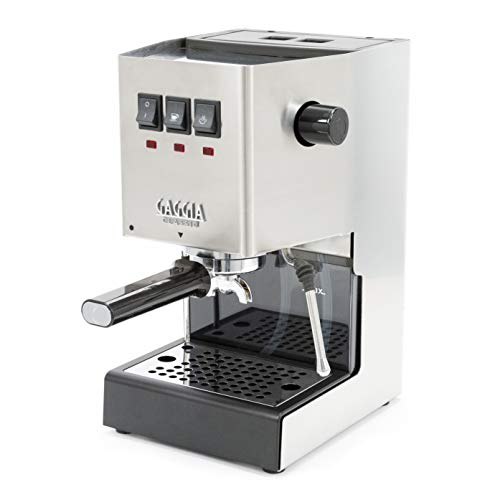
What Is the Gaggia Classic E24?
The Classic E24 is a single-boiler, semi-automatic espresso machine. You grind and tamp the coffee, lock in the portafilter and flip a switch to start and stop the shot. Three rocker switches control power, brewing and steam. There are no presets, no screen and no app.
That simplicity is the point. The Classic has been made in Italy in roughly this form for decades, and it uses commercial-style parts that are easy to find and replace. It’s one of the few machines under $500 that owners routinely keep for many years.

Classic Pro vs Evo Pro vs E24, explained
Gaggia has sold this machine under several names, which confuses a lot of buyers. Here’s the short version:
- Classic Pro (2019): the version most older reviews cover. Aluminum boiler and a higher factory brew pressure. Many owners swapped the pressure valve spring to get 9 bar.
- Classic Evo Pro (2023): small internal updates. In North America it ships with a 9-bar pressure valve, so the spring swap is no longer needed (Coffee Kev, retrieved 2026-11-17).
- Classic E24 (current): the same layout with a lead-free brass boiler and brass group head, plus a 9-bar valve from the factory. Retailers call it the Classic E24, Classic Pro E24 or Classic Evo Pro E24.
On Amazon, the E24 is sold as model RI9380/46, the same US model number the Classic has used for years. Gaggia’s own service manual lists RI9380/46 as the 120V US Classic with an aluminum boiler in its 2018 edition (Gaggia service manual, retrieved 2026-11-17). So check that the listing or box says E24 or brass boiler, especially if you buy from a third-party seller.
Gaggia Classic E24 specs

| Price | $449.76 on Amazon (November 17, 2026) |
| Type | Single-boiler semi-automatic |
| Boiler | Lead-free brass |
| Brew pressure | 9 bar (factory-set pressure valve); 15-bar Ulka vibration pump |
| Portafilter | 58mm stainless steel, commercial size |
| Baskets | Pressurized double, plus standard single and double |
| Valve | 3-way solenoid (dry pucks, allows backflushing) |
| Water tank | 2.1 L (about 71 oz), removable, fills from the top or front |
| Power | 1,350 W (120V US, per Gaggia) |
| PID | No |
| Weight | About 17.8 lb (Tom’s Guide) |
| Colors | Brushed stainless, Thunder Black, Polar White, Classic Blue, Industrial Grey |
| In the box | Portafilter, three baskets, plastic tamper, scoop. No milk pitcher or cleaning tools. |
Espresso Quality
This is where the Classic earns its reputation. Tom’s Guide spent a month with the E24 and said it makes very good espresso, with the brass boiler and group improving thermal stability (Tom’s Guide, retrieved 2026-11-17).
Three things make the difference. The 58mm portafilter is the size used in cafe machines, so you get a wide, even coffee bed and access to the best baskets and tools. The 9-bar pressure valve means shots aren’t forced through at too high a pressure. And the 3-way solenoid valve releases pressure after the shot, so the puck comes out dry and you can backflush the group to clean it.
The included standard baskets reward good technique. Change the grind and the taste changes, which is exactly what you want if you plan to get better at espresso. The pressurized basket is there for pre-ground coffee while you’re getting started.
Temperature without a PID
Most machines at this price have a PID, a digital controller that holds the water at a set temperature. The Classic uses a simple thermostat instead, so the temperature swings up and down as the heater cycles on and off. Owners manage this with a short routine called temperature surfing.
The brass boiler makes this easier than it used to be. Whole Latte Love found the brass boiler switched on 4 times over the same period the old aluminum boiler switched on 7 times, which means steadier heat between cycles (Whole Latte Love, retrieved 2026-11-17). Tom’s Guide said surfing took about 1 to 2 minutes of fiddling, much less than some rival single-boiler machines.
A simple routine that works for most owners:
- Turn the machine on and let it heat with the portafilter locked in, so the group warms too.
- When the brew-ready light is on, run a short flush of water through the group into a cup.
- Wait for the ready light to come back on.
- Prepare your coffee, lock in and pull the shot.
The goal is consistency, not a perfect number. Do the same thing every time and your shots will be repeatable.
Some owners install an aftermarket PID kit later. It’s a popular mod, but it means opening the machine, so check your warranty first. You don’t need one to make great espresso on the E24.

Where it falls short
The Classic needs more from you than most machines at this price. It has a steep learning curve for beginners, and it won’t hide a bad grind. If you use cheap pre-ground coffee in the standard baskets, the shots will run fast and taste thin.
The drip tray also sits high, which Tom’s Guide found limits clearance for some cups and scales. Use short espresso cups, or measure your favorite mug before buying.
Steaming Milk
For its size, the Classic’s steam wand is strong. Tom’s Guide found it textured milk for an 8 oz flat white in under 10 seconds, even with the valve only half open, and produced velvety milk for flat whites and small cappuccinos.
The limit is volume. With a small single boiler, steam runs out on large lattes and full milk jugs. Gaggia claims the brass boiler steams 25% better, but Whole Latte Love measured both the brass and aluminum versions heating 5 oz of milk to 140°F in 24 seconds. Expect good results for one or two small milk drinks, not a round of big lattes.
You also can’t brew and steam at the same time. After the shot, flip the steam switch and wait about 30 seconds for the boiler to reach steam temperature. Pull the shot first, then steam. After steaming, run water through the group until it stops spitting before you pull another shot.
There’s no milk pitcher in the box. A 12 oz pitcher suits the Classic’s best drink sizes.
Living With It Every Day
Heat-up. The boiler is ready within a couple of minutes, though the group and portafilter take longer to warm fully. Many owners switch it on a few minutes before they want coffee.
Water tank. The 2.1 L tank is generous for a machine this size, and you can refill it from the top without moving the machine.
Cleaning. Rinse the portafilter after each shot and purge and wipe the steam wand every time. Because of the solenoid valve, you can backflush the group with a blank basket and a little espresso machine cleaner, such as Urnex Cafiza powder ($19.99, 4.8 stars from 8,463 ratings). Descale on a regular schedule, more often with hard water. Our descaling guide covers espresso machines.
Repairs. This is the Classic’s long-term advantage. It’s easy to open, uses standard parts, and has a large community of owners who share fixes. Tom’s Guide noted reports of lifespans up to 15 years.
Build. The body is steel, but a few parts, including the steam wand and purge pipe, feel less solid than the rest, according to Tom’s Guide.

What Owners Say
On Amazon, the listing has 4.3 stars from 3,224 ratings, with 500+ bought in the past month. Keep in mind that this listing has carried earlier versions of the Classic, so many of those ratings are for pre-E24 machines.
What owners like: shot quality and crema, the Italian build and steel finish, and how well it works as a first serious machine. Many say their espresso tastes balanced, not sour or bitter, once they dial it in.
What owners don’t like: reliability is mixed. Amazon’s review summary notes that some owners expect it to last for years, while others say it stopped working properly after about 1.5 years. Leaks come up in a few dozen reviews, and opinions on cleaning are split.
Because parts are cheap and easy to swap, many of those issues are fixable rather than fatal. Still, buy from a seller with good returns, register the warranty, and descale on schedule.
What a Complete Setup Costs
The Classic’s price is only part of the cost. You’ll need a grinder that can handle standard 58mm baskets, a milk pitcher, and ideally a better tamper. Here’s what a full kit looks like with prices from Amazon on November 17, 2026:
| Setup | What’s included | Total |
|---|---|---|
| Starter | Classic E24 + Baratza Encore ESP ($199.95) + 12 oz pitcher ($19.95) | About $670 |
| Recommended | Classic E24 + DF54 grinder ($260) + pitcher + 58.5mm tamper ($42.99) | About $773 |
| Enthusiast | Classic E24 + Eureka Mignon Notte ($299) + pitcher + tamper + bottomless portafilter ($69.99) | About $882 |
For comparison, the Breville Barista Express with a built-in grinder was $689.99. The Classic setups cost more, but each part can be replaced or upgraded on its own. Our best espresso machines under $500 guide explains why we budget for the grinder first.
You’ll Need a Real Espresso Grinder
The standard baskets only work well with fresh coffee ground fine and adjusted in small steps. A blade grinder or a basic drip grinder won’t get there. Our espresso grinder guide matches grinders to machines, and for 58mm machines like the Gaggia Classic we point to the DF54, DF64 Gen 2 or a Eureka Mignon.
Not ready to buy a grinder? Use the pressurized basket with fresh pre-ground espresso coffee for now. You’ll get a decent shot while you save up. Our best coffee beans for espresso guide has picks for both.
Best Upgrades for the Gaggia Classic E24
The Classic uses standard 58mm baskets, so tampers and screens sized at 58.3 to 58.5mm fit inside them. These are the upgrades worth buying, in order:
- A milk pitcher. None comes in the box. The De’Longhi 12 oz milk frothing jug ($19.95, 4.8 stars from 13,909 ratings) is the right size for the Classic’s best milk drinks.
- A spring-loaded tamper. The included plastic tamper is the weakest part of the kit. The Normcore 58.5mm spring-loaded tamper V4 ($42.99, 4.6 stars from 3,402 ratings) presses with the same force every time.
- A bottomless portafilter. It lets you see exactly how the shot flows, which makes dialing in much faster. The Normcore 58mm naked portafilter for the Gaggia Classic Pro ($69.99, 4.4 stars from 2,552 ratings) comes with an 18g basket.

Prices and ratings were checked on Amazon on November 17, 2026. For more tools, including WDT tools and puck screens, see our best espresso accessories. A coffee scale is the next most useful buy.
Gaggia Classic E24 vs Breville Bambino Plus
These two are the most common choice at around $450 to $500. They suit different people.
| Gaggia Classic E24 | Breville Bambino Plus | |
|---|---|---|
| Price (Nov 17, 2026) | $449.76 | $499.95 |
| Heating | Brass boiler, thermostat | Fast heater with PID |
| Portafilter | 58mm commercial | 54mm |
| Milk | Manual steam wand | Automatic steam wand |
| Accessories | Few | More included |
| Repairability | Excellent, standard parts | Harder to service at home |
| Best for | Learning espresso, long-term ownership | Easy lattes and cappuccinos |
Tom’s Guide recommended the Bambino Plus for buyers who want value out of the box. We agree. If you mostly drink lattes and want the milk done for you, get the Bambino Plus. If you want to learn espresso and keep the machine for a decade, get the Classic.
Gaggia Classic E24 Alternatives
Breville Bambino: the cheaper way in
The Breville Bambino ($299.95) heats up in 3 seconds and uses standard 54mm baskets. Pair it with a grinder and you get a complete setup for close to the price of the Classic alone. Read our Breville Bambino review.
Breville Barista Express: grinder included
The Barista Express ($689.99) puts the grinder and machine in one box. It’s easier to start with, but harder to repair. Our Barista Express review compares it with the Gaggia.
Cheaper 58mm machines
If you want the 58mm format for less, our under-$500 guide covers the KitchenAid KES6403 and the Gemilai Owl G3006. They cost less, but neither has the Classic’s long track record.
Who Should Buy It, and Who Should Skip It
Buy the Gaggia Classic E24 if:
- You want to learn espresso properly and enjoy the process.
- You mostly make espresso, cortados, flat whites or small cappuccinos for yourself.
- You want a machine you can repair and upgrade for years.
- You have, or will buy, a real espresso grinder.
Skip it if:
- You want everything included and easy from day one.
- You make big lattes or several milk drinks in a row.
- You don’t want to spend another $200 to $300 on a grinder.
- You want a screen, presets or automatic milk.
Frequently Asked Questions
What’s the difference between the Gaggia Classic Pro and the E24?
The E24 replaces the Classic Pro’s aluminum boiler with a lead-free brass boiler and group, which hold temperature better. It also ships with a 9-bar pressure valve. The layout, portafilter and controls are the same.
Does the Gaggia Classic E24 have a PID?
No. It uses a thermostat, so owners use a short temperature surfing routine for consistent shots. Aftermarket PID kits exist, but you don’t need one.
Is the Gaggia Classic E24 good for beginners?
It’s good for beginners who want to learn. It has a steeper learning curve than machines with presets or automatic milk, and it needs a proper grinder. If you want easy results right away, the Bambino Plus is friendlier.
What size is the Gaggia Classic portafilter?
58mm, the commercial standard. Tampers and puck screens sized at 58.3 to 58.5mm fit the baskets.
Do I need to do the OPV mod?
Not on the E24 sold in North America. Gaggia sets the pressure valve to 9 bar at the factory, which was the most common mod on older Classics.
How long does a Gaggia Classic last?
With regular descaling and the occasional gasket replacement, many owners keep theirs for 10 years or more, and Tom’s Guide noted reports of up to 15 years. Some owners do report problems within the first two years, so register the warranty.
Can the Gaggia Classic E24 use pre-ground coffee?
Yes, with the included pressurized basket. For the standard baskets, you’ll get much better results with fresh, finely ground coffee.
Should I buy the Gaggia Classic or the Bambino Plus?
Get the Bambino Plus if you want easy, automatic milk and more included accessories. Get the Gaggia Classic if you want to learn espresso, prefer a 58mm portafilter, and want a machine you can repair for years.
Bottom Line
The Gaggia Classic E24 is still the machine to buy if you want real espresso skills and a machine that lasts. The brass boiler makes it steadier than the old Classic Pro, and the 58mm portafilter, 9-bar valve and strong steam wand put it ahead of most machines at this price. Budget for a grinder and a few accessories, and accept a little temperature routine.
Best setup: Classic E24 + DF54 grinder for about $710 before accessories.
For latte drinkers: the Breville Bambino Plus.
First upgrades: a 12 oz milk pitcher and a 58.5mm spring-loaded tamper.
Check Gaggia Classic E24 Price on Amazon


