

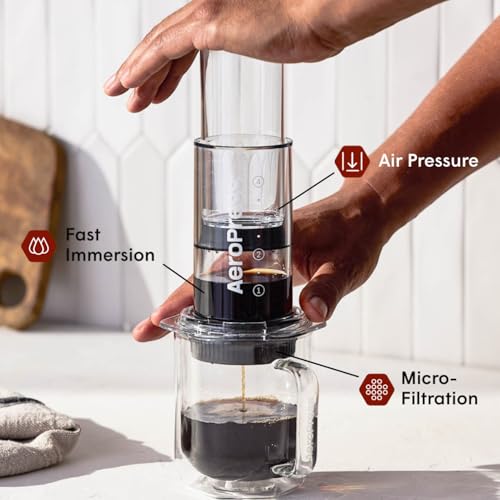
AeroPress doesn’t fit neatly into “French press” or “pour-over,” it borrows from both, plus a shot of actual air pressure, which is where the name comes from. Coffee steeps briefly in the chamber like a French press, then you push a plunger through it, forcing the coffee through a paper or metal filter under gentle pressure, similar in principle to how espresso works, just at a fraction of the pressure and cost. The result is a cup that’s cleaner than a French press (the filter catches the sediment a French press’s mesh lets through) and rounder than most pour-over methods, with less bitterness than either.
It’s also nearly indestructible, brews in under two minutes, and cleans up by popping the used puck straight into the trash or compost. That combination is why it’s become the default recommendation for anyone asking “what should my first non-drip-machine coffee maker be.” Below is the quick-comparison table, then the two brewers, then the accessories actually worth adding.
Quick Comparison
| Product | Best For | Type | Brew Capacity |
|---|---|---|---|
| AeroPress Original | Best Overall/Home Use | Brewer | Up to 10oz |
| AeroPress Go | Best for Travel | Brewer | Up to 8oz |
| Fellow Prismo | Best for Espresso-Style | Filter cap accessory | N/A |
| AeroPress Flow Control Cap | Best for Full Immersion Control | Filter cap accessory | N/A |
| AeroPress Stainless Steel Filter | Best Reusable Filter | Filter accessory | N/A |
AeroPress Original – Best Overall/Home Use

The Original is still the reference point every other AeroPress model gets compared against, and for home use it’s the one to buy. It brews up to 10oz per pressing, more than the Go’s 8oz, and comes with the full accessory set: a funnel that makes filling the chamber genuinely easy over a normal-sized mug, a proper scoop, a stirring paddle, and 350 paper micro-filters, enough to not think about buying more for months.
The brewing process is simple enough to not need much explanation: add coffee and water, stir, wait roughly 30 seconds, press. The whole cycle from start to clean chamber takes about a minute, and because the plunger wipes the chamber as it travels, there’s no scrubbing afterward, just pop the puck out and rinse.

It’s genuinely durable, made from BPA-free plastic that’s held up for two decades of daily use in a lot of households, but it is bulkier than the Go and doesn’t come with its own travel mug, so if portability matters more than home brewing volume, the Go below is the better starting point.
Specs: Up to 10oz brew capacity, includes funnel, scoop, stirrer, filter cap, and 350 paper micro-filters, BPA-free construction, made in USA, includes zippered tote bag.
Pros: Largest brew capacity of the two brewers here, comes with the fullest accessory kit, genuinely fast cleanup, near-indestructible build, huge body of online recipes and community support since it’s the original model.
Cons: Bulkier than the Go for packing, doesn’t include its own travel mug, requires buying paper filters separately once the included 350 run out (though that takes most people months).
Not the right fit if: you’re brewing on the road more often than at home, in which case the Go below packs down into its own mug for exactly that situation.
AeroPress Go – Best for Travel
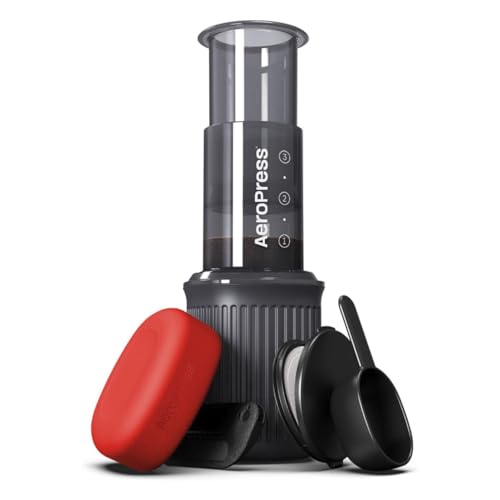
The Go takes the identical brewing method, chamber, plunger, and filter system, and shrinks the whole kit down to fit inside its own lightweight, microwaveable mug with a silicone lid. That’s the entire pitch: everything you need, including a folding stirrer and a compact scoop, packs into one self-contained unit that’s genuinely easy to toss in a backpack, carry-on, or camping kit.
Because the chamber and seal diameter are identical to the Original, most third-party accessories, including the Prismo and metal filters below, fit the Go without any modification. That matters if you already own AeroPress accessories and are just adding a travel-sized brewer to the collection.

The tradeoff is capacity, 8oz versus the Original’s 10oz, and the included mug is a fairly basic single-wall plastic cup, not insulated or leak-proof the way a dedicated travel mug would be. It’s a genuinely good travel coffee maker, but it isn’t also a great travel mug, treat those as two separate jobs.
Specs: Up to 8oz brew capacity, packs into included microwaveable mug with silicone lid, folding stirrer, compact scoop, same chamber diameter as the Original.
Pros: Fully self-contained travel kit, identical brew quality to the Original, compatible with all standard AeroPress accessories, genuinely compact for backpacks and luggage.
Cons: Smaller brew capacity than the Original, included mug isn’t insulated or leak-proof, single-wall plastic build feels less premium than a dedicated travel mug.
Not the right fit if: you’re brewing primarily at home and want maximum capacity, in which case the Original above holds more per press.
Fellow Prismo – Best for Espresso-Style

Prismo replaces the standard filter cap with one that has a pressure-actuated valve, which changes how you can brew in a meaningful way: it holds back the coffee until you actively press, rather than letting it drip through as soon as you pour water in. That lets you do a true full-immersion brew without needing to flip the AeroPress upside down first, the awkward “inverted method” a lot of recipes call for with the stock setup.
It also swaps the paper filter for a reusable etched stainless steel mesh, fine enough to hold back grounds while producing a noticeably thicker, more espresso-like shot than the stock cap allows, genuinely useful for milk drinks like lattes and cappuccinos where you want concentrated coffee to cut through.
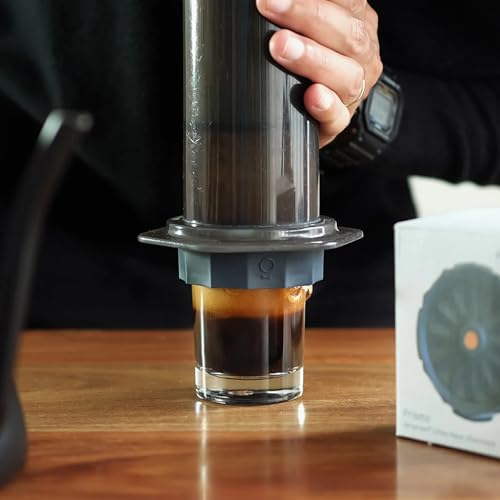
The no-drip seal is also handy for cold brew specifically, you can let grounds steep in the fridge overnight without leaking, then press when ready. The honest tradeoff: it’s a genuine investment on top of the brewer itself, and if you’re happy with the standard AeroPress cup, this changes the character of your brew rather than simply improving it.
Specs: Pressure-actuated valve filter cap, reusable etched stainless steel mesh filter, no-drip seal, fits Original, Go, Go Plus, and Clear models.
Pros: No inversion needed for full-immersion brewing, genuinely espresso-like concentration for milk drinks, no-drip seal makes overnight cold brew practical, reusable filter eliminates paper filter costs.
Cons: Additional cost on top of the brewer, changes the cup’s character rather than being a pure upgrade, some AeroPress models reportedly require a bit of extra force to seat it initially.
Not the right fit if: you like the standard AeroPress’s clean, light-bodied cup as-is, in which case the Flow Control Cap below is a gentler accessory that doesn’t fundamentally change the brew style.
AeroPress Flow Control Filter Cap – Best for Full Immersion Control
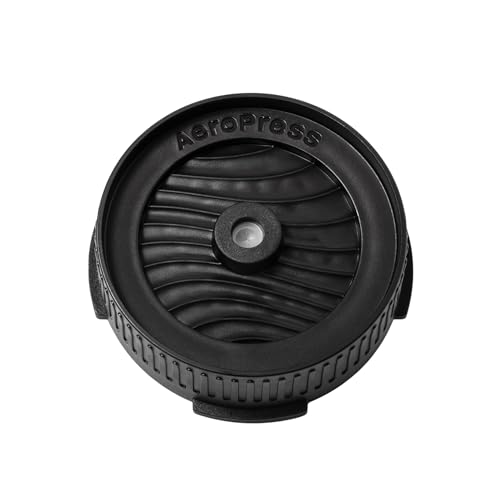
This is AeroPress’s own answer to the same basic problem Prismo solves, preventing drip-through before you’re ready to press, but with a gentler approach that keeps the brew closer to the standard AeroPress character rather than pushing toward espresso concentration. It’s a direct swap for the stock filter cap and gives you real control over steep time independent of how fast you pour, which the standard cap doesn’t allow since coffee starts dripping through immediately.
Because it’s made by AeroPress specifically for their own brewers, fit and compatibility are guaranteed across the current lineup, Original, Go, Go Plus, and Clear all take it without issue. It works with either the standard paper filters or a reusable metal filter underneath.
Worth noting directly from AeroPress: it’s not recommended for Original AeroPress units made before 2014, since an earlier material change can affect the fit. If you have an older unit, check the manufacture details before ordering.
Specs: Direct-fit replacement filter cap, works with paper or metal filters, compatible with Original, Go, Go Plus, and Clear (not pre-2014 Originals), enables cold brew, lattes, and espresso-style drinks.
Pros: Genuine AeroPress part with guaranteed fit on current models, gentler upgrade than Prismo that preserves the classic AeroPress character, works with either paper or metal filters underneath, opens up cold brew and espresso-style recipes.
Cons: Not compatible with pre-2014 Original units, still requires buying filters separately unless paired with a reusable metal one, less dramatic espresso-style concentration than Prismo.
Not the right fit if: you specifically want the strongest, most espresso-like shot possible, in which case Prismo above pushes further in that direction.
AeroPress Stainless Steel Reusable Filter – Best Reusable Filter
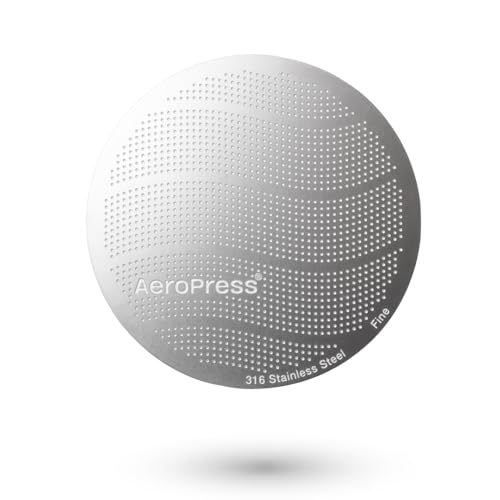
If your only frustration with the AeroPress is buying paper filters, this solves it directly: a fine mesh 316-grade stainless steel filter that drops in as a direct replacement for the paper micro-filters, no cap swap required. 316-grade is a genuine step up from the 304-grade steel used in a lot of cheaper third-party metal filters, more corrosion-resistant over years of repeated use and rinsing.
The mesh is fine enough to keep grounds out while letting more of the coffee’s natural oils through than a paper filter does, which produces a slightly heavier-bodied, more full-flavored cup, a real and noticeable difference, not a marketing claim. It rinses clean in seconds and lasts indefinitely with normal care.
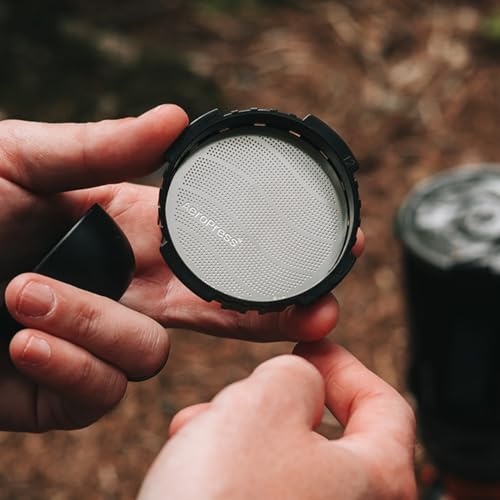
The tradeoff for that heavier body is a small amount of fine sediment in the bottom of the cup that a paper filter would have caught entirely, most people don’t mind it, but if you want a completely clean, sediment-free cup every time, stick with paper.
Specs: 316-grade stainless steel mesh, direct paper filter replacement, fits Original, Clear, and Go models, reusable indefinitely with rinsing.
Pros: Eliminates ongoing paper filter cost entirely, more corrosion-resistant 316-grade steel than typical third-party filters, produces a fuller-bodied cup, rinses clean in seconds.
Cons: Allows a small amount of fine sediment through unlike paper, changes cup character slightly (more body, less clarity), one-time cost that paper filters don’t require upfront.
Not the right fit if: a completely clean, grit-free cup matters more to you than eliminating paper waste, in which case the stock paper filters that come with either brewer above remain the simpler choice.
How to Brew a Basic AeroPress Cup
Rinse a paper filter in the cap to remove the papery taste, then screw the cap onto the chamber. Add roughly 17g of medium-fine ground coffee (a touch finer than drip, coarser than espresso), and pour in water just off the boil up to your target line, most people start around 200-250ml for a standard cup. Stir for about 10 seconds to make sure all the grounds are saturated, let it steep for 30 seconds to a minute, then insert the plunger and press down steadily over about 20-30 seconds until you hear the hiss that means you’ve reached the grounds.
That’s the entire process, and it’s genuinely forgiving. Adjust grind size finer for a stronger cup, coarser for a lighter one, and adjust steep time the same way, longer steeps extract more, which is either what you want or a sign to back off depending on taste.
Frequently Asked Questions
Do I need special coffee for an AeroPress, or does my regular grind work?
Your regular drip grind is close but usually needs to go slightly finer, medium-fine rather than medium, since AeroPress’s short brew time needs a bit more surface area to extract properly in under a minute. If your first cup tastes weak or sour, that’s usually the sign to grind finer next time.
Is the AeroPress Original or Go better for a first-time buyer?
If you’ll mostly brew at home, get the Original, it holds more coffee and comes with the fuller accessory kit. If you travel often or have very limited kitchen storage, the Go’s self-contained mug-and-brewer combo is the more practical pick. The coffee itself is identical either way.
Can I make actual espresso with an AeroPress?
Not true espresso, which requires roughly 9 bars of pressure that a hand-pressed AeroPress can’t replicate, but with an accessory like the Prismo, you can get a concentrated, espresso-style shot strong enough to cut through milk in a latte or cappuccino. It’s a genuinely good substitute if you don’t own a dedicated espresso machine, not an identical replica.
How long do the included paper filters last, and are they compostable?
The Original ships with 350 filters, which lasts most single-cup daily users several months. AeroPress’s white paper micro-filters are made from chlorine-free paper and are compostable, so if you’re not switching to a reusable metal filter, they’re at least a low-waste disposable option.
Bottom Line
For home brewing, the AeroPress Original is still the right starting point, largest capacity and the fullest accessory kit. For travel, camping, or office use, the AeroPress Go packs the identical brew method into its own mug. Once you’ve got a brewer, the two upgrades actually worth adding are the Fellow Prismo if you want espresso-style concentration for milk drinks, or the AeroPress Flow Control Cap for a gentler full-immersion upgrade. And if paper filters bother you long-term, the stainless steel reusable filter pays for itself within a few months of daily brewing.
If you already own a French press and are weighing whether to add an AeroPress alongside it, our guide to using a French press covers the brewing method AeroPress borrows half its process from, useful context for seeing where the two genuinely differ.


