

Bad coffee advice spreads faster than good coffee. Someone told you dark roast has more caffeine. Someone else said you need “espresso beans” for a proper shot. Your mum has been keeping her coffee in the fridge for thirty years and insists it keeps it fresh. None of these things are true — and they’re quietly making your coffee worse.
We’ve brewed through enough bad batches and read enough forums to know exactly which myths are doing the most damage at home. This guide covers twelve of the most common ones, explains why they’re wrong, and gives you something practical to do instead. No jargon, no filler — just what actually matters when you’re standing at your counter trying to make a good cup.
If something you’ve always believed shows up on this list, don’t worry. The fix is usually simpler than the myth.
Myth 1: Dark Roast Has More Caffeine
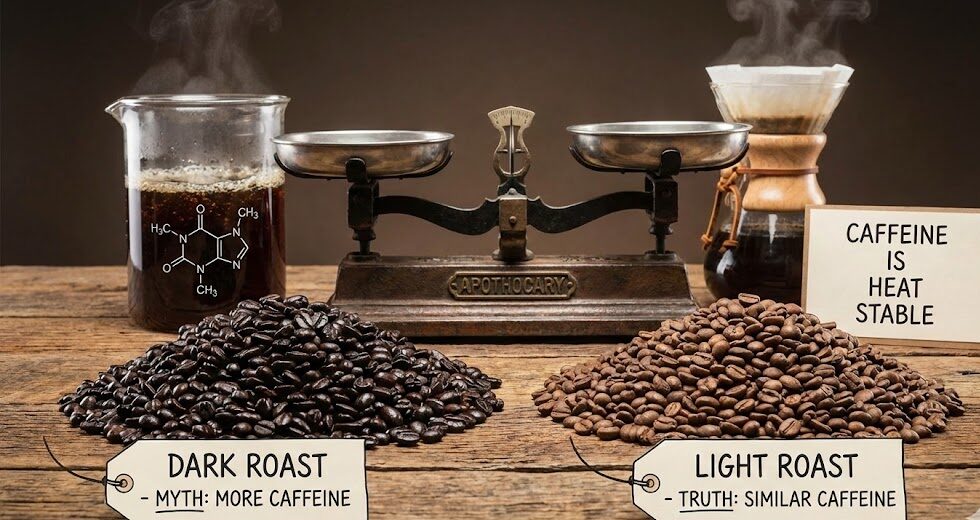
Where it comes from: Dark, oily beans look intense. Intense means strong. Strong means more caffeine. It’s a logical chain that falls apart the moment you check the science.
The truth: Caffeine is remarkably heat-stable. It doesn’t burn off meaningfully during roasting, which means a dark roast and a light roast from the same beans contain nearly identical caffeine levels per bean. Where dark roast can slightly lose out is in volume: the roasting process expands beans and drives off moisture, making dark roast beans physically larger and less dense. Measure by scoop (volume) and a scoop of light roast — denser, smaller beans — can actually contain marginally more caffeine than the same scoop of dark roast. Measure by weight and the difference is negligible either way.
What you’re tasting as “strong” in a dark roast is bitterness and roast character — not stimulant level.
What to do instead: Choose roast level for flavor, not for an energy kick. If you genuinely want more caffeine, adjust your dose or brew ratio. A slightly larger dose of any roast level will do more than switching from light to dark.
Myth 2: You Need “Espresso Beans” for Espresso

Where it comes from: Bags labeled “espresso blend” or “espresso roast” suggest there’s something categorically different inside. There isn’t.
The truth: Espresso is a brewing method, not a bean type. The word “espresso” on a bag is a roaster’s recommendation — a signal that they think these beans will taste good under pressure, usually because they’ve been roasted to bring out chocolatey, low-acid, milk-friendly notes. It is not a legal standard, a processing category, or a guarantee of anything.
Any coffee can be pulled as espresso if you dial in the grind and recipe appropriately. Many specialty roasters actively encourage running their single-origin light roasts through an espresso machine. Done well, you’ll get a shot with fruit-forward complexity you’d never find in a standard espresso blend. Done badly, you’ll get a sour disaster — but that’s a dialing problem, not a bean problem.
What to do instead: Use beans you enjoy and focus on the variables that actually matter: grind size, dose, yield, and shot time. Treat “espresso blend” labeling as a flavor hint, not a prerequisite. If you want to experiment, try pulling a washed Ethiopian through your machine and see what happens. Breville Barista Express Review
Myth 3: Boiling Water Makes Better Coffee

Where it comes from: Hotter feels more powerful. If heat extracts flavor, more heat must extract more flavor. This is directionally true — up to a point.
The truth: Water at a rolling boil (212°F / 100°C at sea level) is slightly too hot for most brewing methods. The ideal range for filter coffee, pour-over, AeroPress, and French Press is 195–205°F (90–96°C). Above that range you start extracting bitter, harsh compounds faster than the desirable ones — the result is a cup that’s sharp and unpleasant in a way that no amount of grind adjustment will fully fix.
The good news: if you don’t have a temperature-controlled kettle, just let the water sit off the boil for 30–45 seconds before pouring. It drops into the right range naturally. The difference between boiling and 30 seconds off the boil is usually about 5–8°F — enough to matter, easy enough to manage without any equipment.
One exception: cold brew, obviously. Another exception: some very dark roasts actually respond well to slightly higher temperatures because the roasting process changes how the compounds extract. But as a default, off the boil is better than straight off the boil.
What to do instead: Let your kettle sit for 30–45 seconds after boiling, or invest in a temperature-controlled gooseneck kettle and aim for 200°F / 93°C. If your coffee tastes harsh and bitter despite a correct grind, water temperature is the next variable to check.
Myth 4: Coffee Dehydrates You
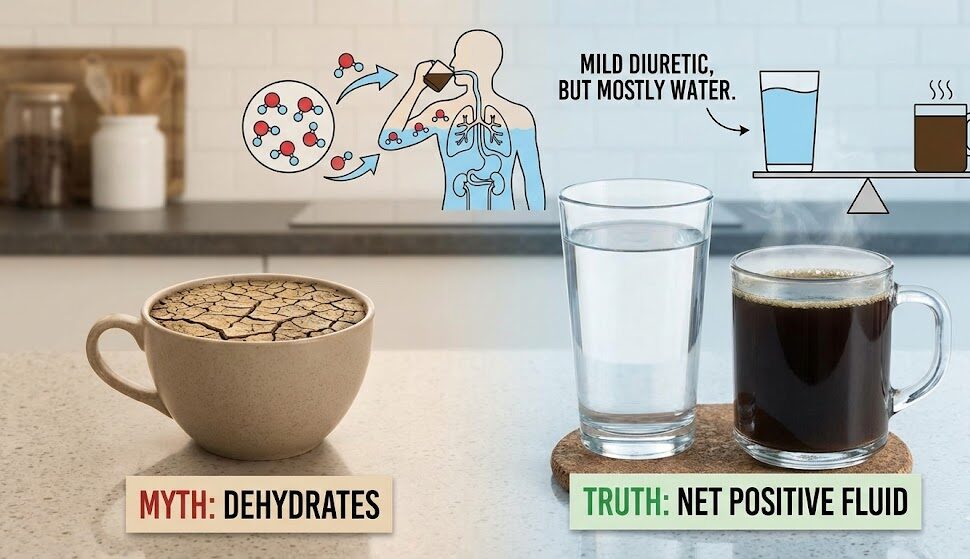
Where it comes from: Caffeine is a mild diuretic. Somewhere along the way, “mild diuretic” became “aggressively dehydrating” in popular understanding, and the myth stuck.
The truth: Coffee does have a weak diuretic effect, but the volume of water in the beverage more than compensates for it in typical consumption. A 250ml cup of coffee contributes net positive fluid to your daily intake — it doesn’t cancel itself out. Research consistently shows that moderate coffee consumption (up to around 4–5 cups per day) does not cause dehydration in healthy adults, and the body adapts to caffeine over time, further reducing any diuretic effect in regular drinkers.
The dehydration myth likely persists because some people notice they urinate more after coffee — which is true, but that’s your kidneys doing their job, not your body losing more fluid than it took in.
What to do instead: Drink your coffee and drink water throughout the day as you normally would. If you’re having a particularly high-caffeine day or exercising in heat, keep water nearby — but that applies to everyone, not specifically to coffee drinkers.
Myth 5: The Fridge Keeps Coffee Fresh

Where it comes from: Cold preserves food. Coffee is food. Therefore cold preserves coffee. The logic is understandable — and wrong.
The truth: Refrigerators are the worst possible environment for coffee beans. They’re humid, full of strong odors from other foods, and opened multiple times a day causing repeated temperature cycling. Coffee is extraordinarily absorbent — it will pick up the smell of last night’s leftovers within days. The moisture in a fridge also begins breaking down the oils in the bean that carry most of the flavor. You’re essentially aging your coffee badly and flavoring it with whatever else is in there.
Freezing is a different story — but only when done correctly. If you’re buying in bulk and genuinely need to store beans for several months, seal them in airtight, moisture-proof bags (ideally vacuum-sealed), freeze once, and thaw only what you’ll use in the next 1–2 weeks. The critical word is once: repeated freeze-thaw cycles are as damaging as the fridge.
What to do instead: Store beans at room temperature in an opaque, airtight container away from direct light, heat, and your stovetop. A ceramic canister with a silicone seal works well. Buy in quantities you’ll finish within 2–3 weeks of the roast date. Freshness beats storage method every time.
Myth 6: Pre-Ground Coffee Is Just as Good If It’s a Good Brand
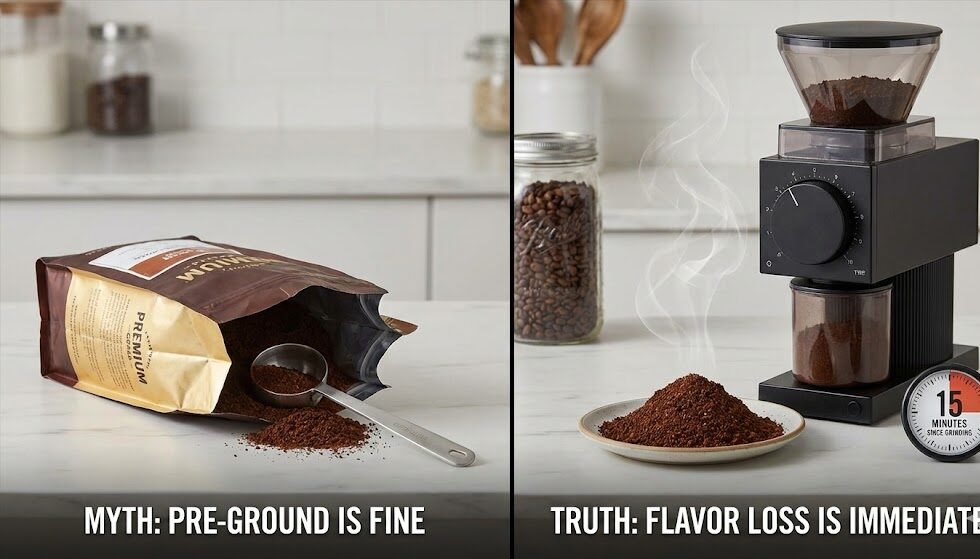
Where it comes from: Premium brands market pre-ground coffee aggressively, and the packaging is often indistinguishable from whole bean. If the brand is good, the quality must be there.
The truth: Once coffee is ground, its surface area increases by hundreds of times over. Aromatic compounds — the ones responsible for everything interesting in the cup — begin escaping immediately. Within 15–30 minutes of grinding, measurable flavor loss occurs. Within hours, significant degradation. By the time you open a bag of pre-ground coffee that’s been sitting on a shelf for weeks or months, most of what made the original beans interesting is already gone.
A bag of pre-ground coffee from a great roaster will produce a worse cup than a bag of mediocre whole beans ground fresh immediately before brewing. This is not a minor difference. It’s one of the biggest single variables in home coffee quality, and it’s the reason specialty coffee shops grind to order.
What to do instead: Buy whole beans and grind right before brewing. A burr grinder is the highest-impact upgrade most home brewers can make — more so than an expensive machine. Even a hand grinder in the $40–60 range will produce dramatically better results than pre-ground. Best Burr Grinders Under $200]
Myth 7: The Fresher the Roast, the Better the Cup

Where it comes from: “Fresh” is universally good in food. Day-old bread is worse than fresh bread. Day-old roast must be worse than yesterday’s roast. Except coffee doesn’t work like bread.
The truth: Freshly roasted coffee needs time to rest before it’s at its best. During and immediately after roasting, beans release significant amounts of carbon dioxide — a process called degassing. If you brew beans too soon after roasting, that CO₂ interferes with extraction: it creates uneven saturation in your coffee bed, produces excessive blooming, and can make shots sour or oddly flat depending on the method.
The sweet spot varies by method and roast level, but as a general guide: espresso benefits from a 7–14 day rest after roast, with some darker roasts needing a full three weeks before they peak. Filter coffee and pour-over typically hit their best flavors at 3–10 days post-roast. Buying beans roasted yesterday isn’t a bonus — it’s a problem.
What to do instead: Check the roast date on every bag, not just the “best before” date. Aim to start brewing 4–7 days after the roast date and finish the bag within 3–4 weeks. If a very fresh coffee tastes gassy, wild, or hollow, give it 3–4 more days and try again before adjusting your recipe.
Myth 8: Cold Brew Is Always Higher in Caffeine
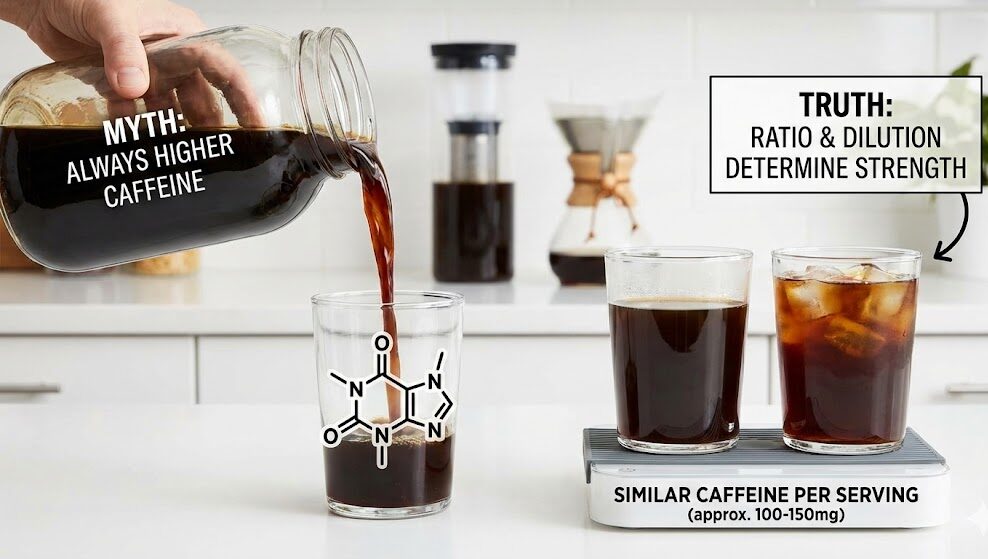
Where it comes from: Cold brew is brewed for 12–24 hours, which sounds exhaustive. Long brew time plus intense flavor must mean maximum caffeine.
The truth: Cold water extracts caffeine less efficiently than hot water. What makes cold brew taste so intense is the coffee-to-water ratio used during brewing — typically 1:4 or 1:5 (very concentrated) compared to a standard drip ratio of around 1:15 or 1:16. When you dilute that concentrate with equal parts water or milk before drinking, as most recipes call for, you end up with a caffeine level broadly comparable to a regular hot brew — often around 100–150mg per 240ml serving depending on the beans and ratio used.
Ready-to-drink cold brew from a bottle may actually be lower in caffeine than a strong pour-over if the manufacturer has diluted it significantly. The only way to know is to check the label or calculate it from the ratio yourself.
What to do instead: If you’re making cold brew for the caffeine, use a higher coffee-to-water ratio and don’t over-dilute. If you’re making it because you enjoy the smooth, low-acid flavor profile — which is the better reason — then enjoy it for what it is, not for what you assume it contains.
Myth 9: Stronger Coffee Just Means Longer Brew Time
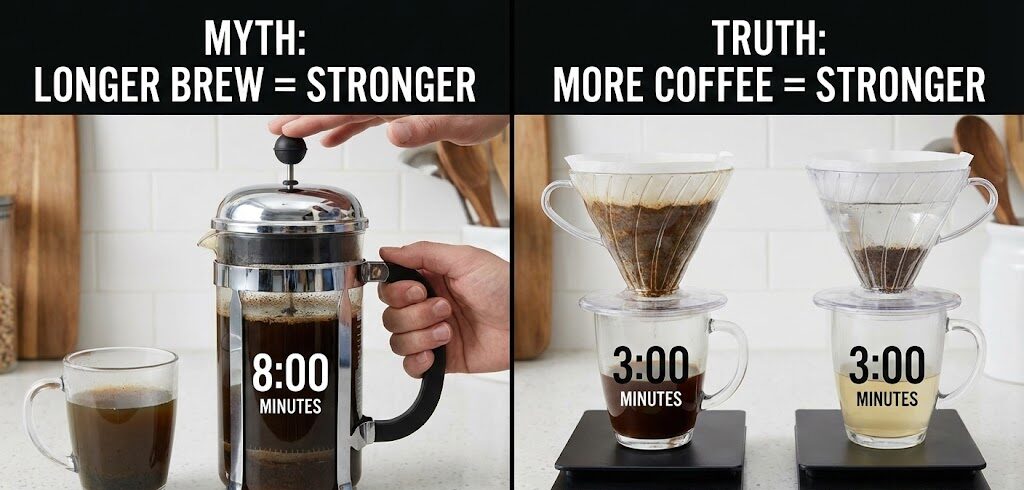
Where it comes from: If brewing extracts flavor, brewing longer extracts more flavor. It’s intuitive, and it produces reliably terrible results.
The truth: Extraction is sequential. Early in the brew process, water pulls the pleasant, soluble compounds first: acids, sweetness, and brightness. As extraction continues, it moves on to heavier, more bitter, astringent compounds. Brewing longer without changing anything else doesn’t make your coffee “stronger” in the enjoyable sense — it makes it over-extracted: harsh, drying, and flat.
What actually controls strength is the coffee-to-water ratio. More coffee relative to water produces a stronger, more concentrated cup in the same brew time. That’s the variable to adjust, not time. Brew time matters — but it’s primarily a dial for extraction balance, not for intensity.
What to do instead: If your coffee tastes weak but clean, add more coffee or use less water. If it tastes bitter and drying, shorten the brew time or coarsen your grind — don’t add more coffee. These are two different problems with two different solutions, and confusing them by just “brewing longer” makes both worse.
Myth 10: Expensive Machines Make Better Coffee
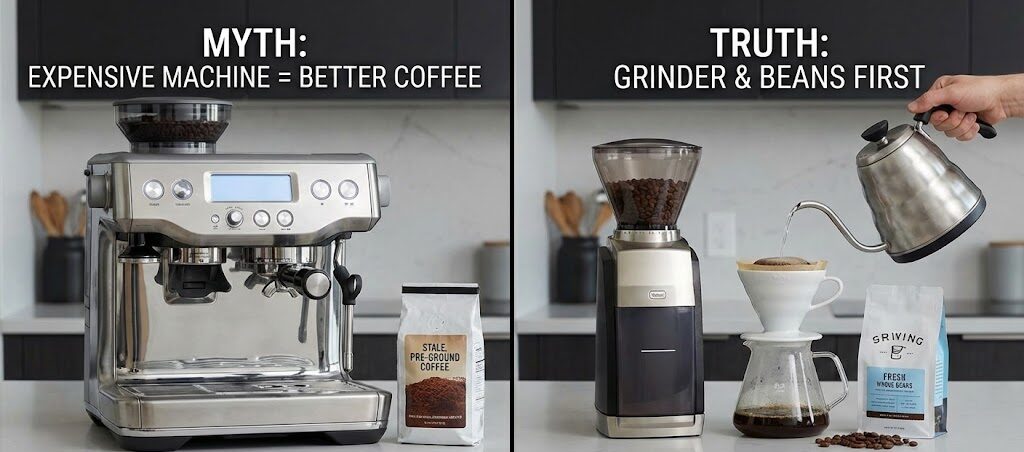
Where it comes from: Higher price signals higher quality in most categories. It’s not an unreasonable assumption — it just doesn’t map onto coffee equipment the way people expect.
The truth: Equipment matters, but the order of impact is counterintuitive. A $50 burr grinder paired with a $30 French Press and good beans will consistently outperform a $1,000 espresso machine paired with a blade grinder and stale pre-ground coffee. The grinder is the most impactful piece of equipment in any home setup, because grind consistency determines extraction consistency — and no machine, regardless of price, can compensate for a bad grind.
Beyond the grinder, the next biggest variable is beans: fresh, quality beans brewed with correct technique on modest equipment beats stale beans pulled through a premium machine every time. Machines matter — but they’re third in line, not first.
What to do instead: Before upgrading your machine, upgrade your grinder. Before upgrading your grinder, audit your beans — are they fresh, are you storing them correctly, are you brewing within the right window after roast? Solve those first. Then consider the machine.
Myth 11: All Coffee Tastes Basically the Same
Where it comes from: If you’ve only ever drunk supermarket coffee or chain-brand espresso, this is an understandable conclusion. That coffee is deliberately blended for consistency and inoffensiveness, which flattens the range.
The truth: Coffee is one of the most chemically complex beverages on earth — more aromatic compounds than wine. Origin, variety, processing method, altitude, roast profile, and freshness all dramatically change what ends up in the cup. An Ethiopian Yirgacheffe processed naturally can taste like blueberry jam and jasmine. A Brazilian natural can taste like dark chocolate and hazelnut. A Colombian washed can be clean, crisp, and citrusy. These are not the same drink.
Processing alone creates enormous variation: washed coffees are clean and bright; natural-processed coffees are fruity and funky; honey-processed coffees sit somewhere between. Roast level overlays all of this, amplifying or suppressing the underlying character of the bean. The range is genuinely as wide as wine if you know where to look.
What to do instead: Treat coffee like wine or craft beer and start experimenting deliberately. Try a washed light roast from East Africa next to a natural from South America and brew them the same way. The difference will make the myth feel absurd. Take notes on what you like — fruity, chocolatey, bright, low-acid — and use that vocabulary to guide future purchases from specialty roasters.
Myth 12: Water Quality Doesn’t Matter — Coffee Is Mostly Water Anyway
Where it comes from: If coffee is 98% water, the water must not matter much. What could go wrong?
The truth: Because coffee is 98% water, the water matters enormously. Minerals in water — primarily magnesium and calcium — actively participate in extraction, binding to flavor compounds and carrying them into the cup. Water that’s too soft (low mineral content) under-extracts and produces flat, hollow coffee. Water that’s too hard (high mineral content) can scale your equipment and over-extract certain compounds, producing harsh, chalky results. Heavily chlorinated water adds an off-flavor that no amount of good beans will mask.
The SCA (Specialty Coffee Association) recommends water with a total dissolved solids (TDS) of around 150 ppm and a pH between 6.5–7.5 as optimal for coffee brewing. Most decent tap water in the UK and Europe falls close to this range. If yours doesn’t — or if your tap water tastes noticeably of chlorine — a simple carbon filter jug (like a Brita) solves the problem for a few pounds.
What to do instead: If your coffee tastes flat despite good beans and correct technique, your water is worth investigating. Run it through a carbon filter, or buy a bottle of still mineral water with moderate mineral content (aim for 100–200 ppm TDS) and compare the results. The difference is often surprising.
📋 Quick Myth-Buster Reference
| The Myth | The Truth in One Line |
|---|---|
| Dark roast = more caffeine | Caffeine barely changes with roast level |
| Need “espresso beans” for espresso | Espresso is a method. Any bean works. |
| Boiling water is best | 195–205°F / wait 30–45 sec off boil |
| Coffee dehydrates you | Coffee contributes net positive fluid |
| Fridge keeps coffee fresh | Fridge = moisture + odors. Room temp, airtight. |
| Pre-ground is fine if brand is good | Grind fresh. Always. |
| Freshest roast = best cup | Beans need 4–14 days to degas after roast |
| Cold brew is always highest caffeine | Ratio drives caffeine, not method |
| Longer brew = stronger coffee | More coffee = stronger. Longer = more bitter. |
| Expensive machines = better coffee | Grinder first. Beans second. Machine third. |
| All coffee tastes the same | Origin, process, and roast change everything |
| Water quality doesn’t matter | Coffee is 98% water. Filter if your tap is harsh. |
Final Thoughts
Most of these myths share a common root: they oversimplify a complex drink into one-liners that feel true but don’t survive contact with a kettle. Dark roast feels stronger, so it must have more caffeine. Cold brew steeps for hours, so it must be potent. Boiling water is hot, so it must extract more. None of it holds up.
The good news is that correcting most of these mistakes costs nothing. You don’t need new equipment to stop using the fridge, to let your beans degas properly, or to pull your kettle off the boil before pouring. You don’t need a bigger budget to start buying whole beans and grinding fresh. The biggest improvements in home coffee quality tend to come from changing habits, not spending money.
If you want to go further, start with the grinder — it’s the single piece of equipment that will do more for your cup than anything else on the market. Then work on your beans: find a roaster whose flavor profiles you like, pay attention to roast dates, and store them correctly. By the time you’ve done those two things, you’ll be brewing better coffee than most people ever manage — regardless of what machine is on your counter.